
Sharebird
All events

This event has ended!

Virtual Event
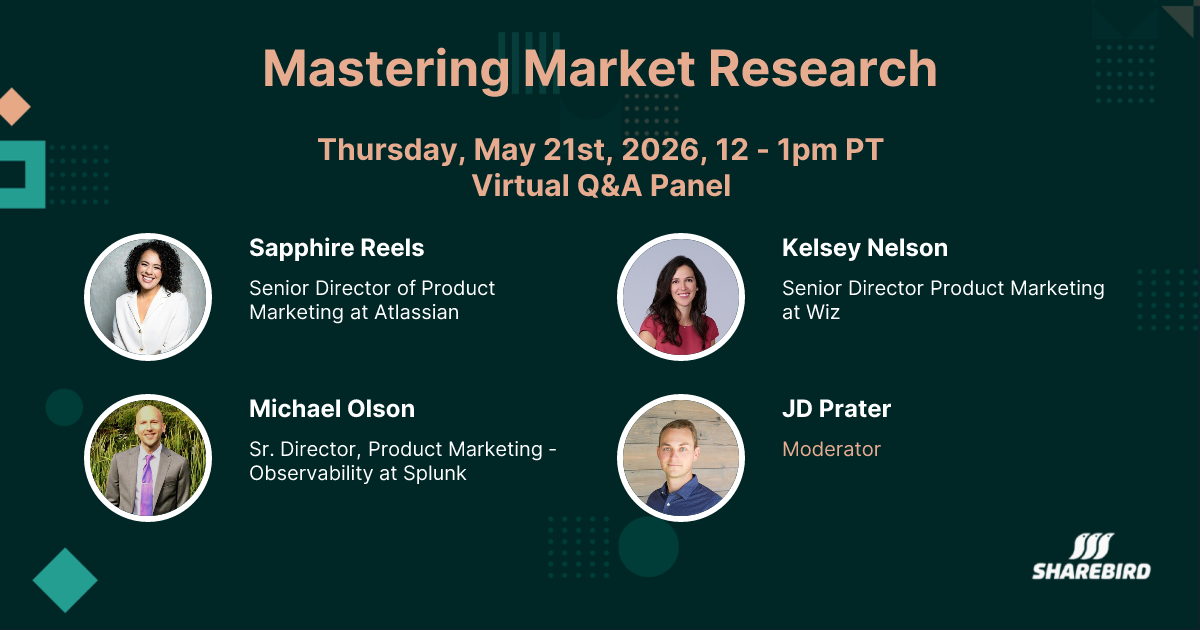
Mastering Market Research

Mastering Market Research

Thursday, May 21st, 2026 • 12pm–1pm PT ·

Join over 200+ product marketers to learn how PMM leaders at the fastest-growing tech companies leverage market research to drive strategic decisions, refine messaging, and execute high-impact go-to-market strategies.

This virtual event will provide actionable insights and proven techniques to gather, analyze, and apply market research effectively. Learn how to extract meaningful customer and competitor insights, influence key stakeholders with data-driven storytelling, and ensure your marketing efforts are backed by research-driven decisions.

Date: Thursday, May 21st, 12–1 PM PT (3–4 PM ET)
Location: Online (link will be sent to registrants prior to the event)
Cost: Free-but seats are limited, so be sure to register early!


Top Questions

  • What are the best sources for market research when your org/company doesn't have a research team?

    JD Prater
    JD Prater

    Ting VP of Marketing • May 22

    Use Notebook LM from Google to synthesize large volumes of articles, reports, and videos into actionable insights quickly and for free. Notebook LM is a scrappy but powerful tool: keep a running list of every article, blog, research report, and YouTube video relevant to your market and feed them all in. It's remarkably good at synthesizing 50+ sources, including competitive webinars. The Gemini models powering it are only getting stronger. You can also feed in your own materials for battle-testi ...Read More

    314 Views
    Kelsey Nelson
    Kelsey Nelson

    Wiz Senior Director Product Marketing • May 22

    Use a blend of internal data (Salesforce, call logs, customer interviews) and third-party research to understand both existing customers and those you're not yet reaching. New AI-powered synthetic research tools are also emerging as cost-effective options. When refreshing a go-to-market motion, pull from multiple data sources: - **Quantitative internal data**: Salesforce records, call logs, usage data - **Qualitative internal data**: Interviews with sales teams, internal stakeholders, and custom ...Read More

    347 Views
    Michael Olson
    Michael Olson

    Splunk Sr. Director, Product Marketing - Observability • May 22

    The most effective sources include direct customer conversations, Gong call transcripts fed into AI tools, analyst reports, peer review sites, Reddit communities, and real-time B2B message testing tools like Wynter. Here are the most useful channels for market research without a dedicated research team: 1. **Talk to customers** — Ideally, be pulled into customer meetings and sales calls proactively. Even as a fly on the wall, you gain invaluable insight. 2. **Gong transcripts** — If your company ...Read More

    327 Views
    Sapphire Reels
    Sapphire Reels

    Atlassian Senior Director of Product Marketing • May 22

    Partner with third-party research firms like GLG for statistically significant primary research, especially when you need market credibility. Market research is a craft, and getting statistically significant data matters. For a recent white paper and campaign at Atlassian, the team partnered with GLG (Gerson Lehrman Group) to conduct both qualitative and quantitative primary research. The goal was to establish a credible point of view on where a market category was going. Going to existing custo ...Read More

    313 Views
  • Do you have an example of when market insights influenced business change i.e. product roadmap

    Kelsey Nelson
    Kelsey Nelson

    Wiz Senior Director Product Marketing • May 22

    Customer interviews uncovered an unexpected third bucket of high-value use cases, which led to a fundamental pivot in pricing model — moving to use-case-agnostic pricing and launching a freemium tier. The scenario: a product had been launched for its first use case, and the team was evaluating whether to expand to a second use case and potentially shift pricing. The research process: 1. Interviewed a series of customers using a pricing questionnaire 2. Spent significant time asking about current ...Read More

    330 Views
    Sapphire Reels
    Sapphire Reels

    Atlassian Senior Director of Product Marketing • May 22

    Market research disproved internal assumptions about mid-market packaging, ultimately preventing a premature SKU launch and redirecting the team toward a leaner sales play instead. The context: an enterprise product was being considered for a mid-market version. Internally, there were strong assumptions — based on existing customer feedback — that mid-market buyers would want depth in specific use case capability sets rather than breadth. A quick third-party survey of the mid-market revealed the ...Read More

    339 Views
    Michael Olson
    Michael Olson

    Splunk Sr. Director, Product Marketing - Observability • May 22

    Market research helped define an entirely new product category — Customer Identity and Access Management — by combining outside-in feedback from target ICPs and analysts to find language that resonated and didn't conflict with existing categories. Early in Michael's career at a pre-Series A startup, the company had built new-to-the-world technology with no existing market category. Initial attempts at category creation failed because the terminology was too inside-out — it wasn't customer langua ...Read More

    320 Views
  • I'm just starting out with market research. What should I focus on first?

    Sapphire Reels
    Sapphire Reels

    Atlassian Senior Director of Product Marketing • May 22

    Start with your hypothesis — what you assume to be true — before diving into sources or methods. The goal is not to prove your hypothesis right, but to use it as a structured starting point for uncovering truth. When beginning market research, the most important first step is forming a clear hypothesis. Think of it like a scientist: you have some baseline understanding of what you think to be true, and that shapes your research direction. Critically, you should never go out simply trying to prov ...Read More

    324 Views
    Kelsey Nelson
    Kelsey Nelson

    Wiz Senior Director Product Marketing • May 22

    Write out structured hypothesis statements with sub-questions to validate them, and consider starting with persona research before competitive or product research. Structurally, write out statements such as: 'This is what I want to explore, this is what I think to be true, and here are the three questions I'll use to validate that.' Having multiple hypotheses — including sub-proof points — helps you understand whether your overall hypothesis is correct. Think of it like writing a great survey or ...Read More

    342 Views
    Michael Olson
    Michael Olson

    Splunk Sr. Director, Product Marketing - Observability • May 22

    Start with deductive reasoning — form a point of view first, then use outside-in research and customer feedback to validate or disprove it. Think like a GM responsible for your product's success in market. As product marketers, we should strive to think like General Managers — responsible for the success of our product in market. That means having a point of view as a starting point, then looking for outside-in research and customer feedback to either disprove or validate that approach. Market r ...Read More

    328 Views
  • where to start for a company doing market research for the first time?

    Kelsey Nelson
    Kelsey Nelson

    Wiz Senior Director Product Marketing • May 22

    Use Notebook LM to get a baseline, then set up automated systems to keep research fresh — including Slack channels for competitor news and layered notebooks for ongoing synthesis. Starting with Notebook LM to synthesize and get a baseline is genuinely effective. Beyond that, to avoid research going stale: - **Create Slack channels** that automatically surface competitor news in one place - **Layer notebooks**: You could have one notebook per competitor, feeding it new information as it comes out ...Read More

    335 Views
    JD Prater
    JD Prater

    Ting VP of Marketing • May 22

    Start with Notebook LM to rapidly synthesize analyst reports, articles, and videos about your market — it educates you on the landscape before you begin primary research. If you're starting from scratch at a new company (especially one without an existing PMM function), the first step is to understand the market before you can research it. Here's the recommended approach: 1. **Go to Notebook LM** (Google's free tool): Gather every analyst report (Gartner, Forrester), article, blog post, and YouT ...Read More

    325 Views
    Michael Olson
    Michael Olson

    Splunk Sr. Director, Product Marketing - Observability • May 22

    Free, zero-budget ways to start market research include reading competitor websites, subscribing to their mailing lists, reading product documentation, and mining peer review sites like G2 and TrustRadius. Here are free starting points that require no budget: 1. **Competitor websites**: Read how competitors position themselves — the problems they solve, the value they provide, how they articulate differentiation. 2. **Mailing lists**: Subscribe to competitor blogs and email lists to see what the ...Read More

    316 Views
  • AI startups are flooding the market research space right now. Which tools are you actually using and why?

    JD Prater
    JD Prater

    Ting VP of Marketing • May 22

    The panelists haven't used ListenLabs or Outset.ai specifically, but the general guidance is to use any AI market research tool as one input among many — never as a sole source of truth. When asked about ListenLabs and Outset.ai (tools that allow you to enter a prompt and have AI field surveys and generate results), none of the panelists had direct experience. However, the general best practice shared was: use any AI tool as one input in your tool belt. Don't rely on a single channel as your be- ...Read More

    340 Views
  • How do you know what you are getting is accurate when you were using AI for market research?

    JD Prater
    JD Prater

    Ting VP of Marketing • May 22

    Use confidence levels to track and communicate how validated your research is, and use LLMs as sparring partners to identify gaps before presenting findings. Think probabilistically, not deterministically. Communicate your confidence level explicitly — e.g., 'I'm at 60% confidence here.' This: - Surfaces gaps that others in the organization may be able to fill - Sets appropriate expectations with stakeholders - Creates a clear path to higher confidence (e.g., 'What do I need to get to 80%?') The ...Read More

    337 Views
    Sapphire Reels
    Sapphire Reels

    Atlassian Senior Director of Product Marketing • May 22

    You can't fully trust AI accuracy without guardrails and external validation — set explicit constraints, use adversarial prompting, and validate high-stakes findings with third-party research. Accuracy checks for AI-generated market research: 1. **Guardrails in prompting**: Explicitly tell the AI not to agree blindly and not to fabricate sources 2. **Adversarial prompting**: Ask the AI to find holes in your research and challenge your conclusions 3. **Third-party validation**: For anything stati ...Read More

    342 Views
  • How does a person avoid hallucination when using AI for market research?

    Sapphire Reels
    Sapphire Reels

    Atlassian Senior Director of Product Marketing • May 22

    Explicitly instruct the LLM not to blindly agree with you and not to fabricate sources. Set source constraints and use AI output as directional input, not final truth — validate high-stakes findings with third parties. Specific tactics to avoid AI hallucination in market research: 1. **Explicit prompting**: Tell the AI directly: 'Don't just blindly agree with me' and 'Don't make up sources.' This is a fundamental guardrail. 2. **Source constraints**: When using chat interfaces or building agents ...Read More

    309 Views
    Kelsey Nelson
    Kelsey Nelson

    Wiz Senior Director Product Marketing • May 22

    Treat AI like a student who believes everything they read on the internet — verify depth of understanding and follow the 'why' chain rather than accepting surface-level outputs. Using AI for research is reminiscent of students who would say 'I found it on the internet, so it must be right.' The antidote is not just source verification, but depth of questioning. Ask yourself: did the AI (or your research process) follow the 'why' chain far enough? Did you get to the right altitude of understandin ...Read More

    328 Views
  • What are non-AI ways to do market research these days?

    Michael Olson
    Michael Olson

    Splunk Sr. Director, Product Marketing - Observability • May 22

    Non-AI market research sources include direct customer conversations, analyst reports, peer review sites, competitor websites and mailing lists, Reddit, Slack communities, and LinkedIn job descriptions. Free and paid non-AI research sources: 1. **Customer conversations**: The most important source. Be pulled into sales calls and customer meetings proactively. 2. **Analyst reports**: Gartner Magic Quadrants, Market Guides, Critical Capabilities, Forrester reports. Many are available for free via ...Read More

    350 Views
    Sapphire Reels
    Sapphire Reels

    Atlassian Senior Director of Product Marketing • May 22

    Partner with third-party research firms like GLG for statistically rigorous primary research — both qualitative and quantitative — especially when you need credible, publishable market data. Market research is a craft. Getting statistically significant information requires proper methodologies — things like regression analysis to test variables are data-science-heavy and require expert execution. For high-stakes research (e.g., a white paper establishing market credibility), partnering with a fi ...Read More

    331 Views
  • how do you keep research relevant / refreshed?

    Kelsey Nelson
    Kelsey Nelson

    Wiz Senior Director Product Marketing • May 22

    Set up automated systems — Slack channels for competitor news, layered Notebook LM notebooks per competitor — so fresh information flows to you continuously rather than requiring manual effort. Practical approaches to keeping research fresh: 1. **Slack channels**: Create channels that automatically surface competitor news in one place as it comes out 2. **Layered notebooks**: Maintain a Notebook LM notebook per competitor. Feed it new information as it's published and query: 'What's new? What sh ...Read More

    340 Views
  • How to get quick market feedback with a high velocity product team (e.g. new launches every months)?

    Kelsey Nelson
    Kelsey Nelson

    Wiz Senior Director Product Marketing • May 22

    Share bite-sized, imperfect signal frequently — weekly updates via Slack or brief summaries — rather than waiting for a polished analysis. Speed of signal matters more than perfection. Practical approach for high-velocity teams: - Don't wait for a perfect analysis. Share three articles with your quick 2 cents on a weekly basis - Use whatever channel your team already uses (Slack, email) to make it automatically digestible - PMs need market signal just as fast as they're shipping — when they say ...Read More

    339 Views
    Sapphire Reels
    Sapphire Reels

    Atlassian Senior Director of Product Marketing • May 22

    Anchor on durable positioning and messaging frameworks so you don't need to re-research with every ship — focus research energy on how new features fit existing frameworks, not on rebuilding from scratch. Problems, use cases, and positioning should be durable. What iterates rapidly is the product's approach to solving those problems — not the problems themselves. So: - Maintain stable positioning and messaging frameworks - When product ships something new, ask: 'How does this fit into our existi ...Read More

    340 Views
    Michael Olson
    Michael Olson

    Splunk Sr. Director, Product Marketing - Observability • May 22

    Use Wynter for real-time B2B message testing — get ICP feedback in under 48 hours — and share bite-sized insights via Slack or short video recordings instead of lengthy reports. Two key approaches for high-velocity environments: 1. **Wynter**: This tool exists specifically to replace months-long research projects. Upload messaging artifacts or surveys, target by ICP job title, and get qualitative and quantitative feedback in under 48 hours at low cost. This is transformative for teams that need ...Read More

    302 Views
  • How do you scale market research efforts to keep up with how fast your product and engineering team is shipping?

    Kelsey Nelson
    Kelsey Nelson

    Wiz Senior Director Product Marketing • May 22

    Share bite-sized, imperfect signal frequently rather than waiting for a polished analysis. Identify trends over time — that's where PMM becomes truly impactful. Don't wait until you have a perfect, packaged update. Instead: - Share three articles with your quick 2 cents on a weekly basis via whatever channel your team uses - Make it automatically digestible — the goal is habit and frequency, not perfection - Product managers need market signal just as fast as they're shipping. When a PM says 'I ...Read More

    348 Views
    Michael Olson
    Michael Olson

    Splunk Sr. Director, Product Marketing - Observability • May 22

    Share bite-sized insights via Slack or short video recordings, and use AI tools and real-time message testing platforms like Wynter to dramatically compress research timelines. Two key approaches: 1. **Bite-sized, high-velocity distribution**: Get short snippets out via Slack, or record yourself on video for 30 seconds and distribute that — rather than feeling like you need to write a dissertation that takes months. 2. **Use the right tooling**: Much of the advice shared throughout this session ...Read More

    329 Views
    Sapphire Reels
    Sapphire Reels

    Atlassian Senior Director of Product Marketing • May 22

    Anchor on durable positioning and messaging — those shouldn't change with every ship. What iterates rapidly is how the product solves problems, not the problems and use cases themselves. Problems, use cases, and positioning should be durable. Typically, those things aren't changing at the same velocity as what's being shipped. What's iterating rapidly is the product's approach to solving those problems. So rather than trying to re-research with every release, stick to your guns on positioning an ...Read More

    340 Views
  • What's the best way to validate the information you uncover in your research?

    Michael Olson
    Michael Olson

    Splunk Sr. Director, Product Marketing - Observability • May 22

    Validation isn't about finding one right answer — it's about collecting enough outside-in data and anecdotal feedback to synthesize a direction that's well-supported and defensible internally. Most of what product marketers do is inherently subjective. It requires synthesis and analysis of ambiguous, nebulous information — shaping it into clear go-to-market strategy, positioning, messaging, and campaigns. There isn't always one right answer. That's precisely why market research is so important: ...Read More

    319 Views
    Kelsey Nelson
    Kelsey Nelson

    Wiz Senior Director Product Marketing • May 22

    Ask enough 'why' questions to reach the right altitude of understanding — make sure you've gone deep enough to confidently answer the business question, not just surface-level data points. Validation is less about verifying the source and more about asking: did you follow the right level of questions? Did you get to the right altitude of understanding on *why*? Following a few 'whys' down as you do research is more important than just validating the source. Ask yourself: do you have enough depth ...Read More

    318 Views
    JD Prater
    JD Prater

    Ting VP of Marketing • May 22

    Use confidence levels to communicate where you are in the research process, and use LLMs as sparring partners to battle-test your findings before presenting them internally. Think like a researcher: communicate your confidence level explicitly. For example, tell your stakeholders 'I'm at about 60% confidence here — I don't yet have the depth or altitude.' This surfaces gaps and often prompts others in the organization to fill them in. Organizations hold more information than you realize — statin ...Read More

    350 Views
    Sapphire Reels
    Sapphire Reels

    Atlassian Senior Director of Product Marketing • May 22

    Use LLMs like Claude or ChatGPT as validation tools, but set explicit guardrails — tell them not to blindly agree and not to fabricate sources. Also validate across different segments and socialize findings early. A few key validation practices: 1. **Use LLMs with guardrails**: When using Claude or ChatGPT, explicitly instruct them: 'Don't just blindly agree with me' and 'Don't make up sources.' This is critical — hallucinated citations are a real risk. Set constraints on what sources to use. 2. ...Read More

    320 Views
  • How are you leveraging AI when conducting market research?

    Sapphire Reels
    Sapphire Reels

    Atlassian Senior Director of Product Marketing • May 22

    Use AI tools for directional speed and early synthesis, but set explicit guardrails — tell them not to blindly agree and not to fabricate sources. Pair AI output with third-party validation for anything high-stakes. Practical AI usage for market research: 1. **Set guardrails explicitly**: Tell the LLM: 'Don't just blindly agree with me' and 'Don't make up sources.' Hallucinated citations are a real risk. 2. **Use for directional speed**: When working on a condensed timeline (e.g., a white paper) ...Read More

    319 Views
    JD Prater
    JD Prater

    Ting VP of Marketing • May 22

    Use Notebook LM to synthesize large volumes of research sources, and use LLMs like Claude as sparring partners to battle-test your findings and messaging before presenting internally. Two primary AI use cases for market research: 1. **Notebook LM for synthesis**: Feed in articles, reports, YouTube videos, competitive webinars, and your own materials. The Gemini-powered models synthesize everything into high-quality output sourced only from what you provide. The audio overview feature gives you a ...Read More

    314 Views
    Michael Olson
    Michael Olson

    Splunk Sr. Director, Product Marketing - Observability • May 22

    Use Gong transcripts fed into ChatGPT or Gemini for customer insight synthesis, and use Wynter for real-time B2B message testing with your ICP in under 48 hours. Key AI-powered approaches: 1. **Gong + AI summarization**: Pop sales call transcripts into ChatGPT or Gemini to get summarized insights. This is a goldmine of customer language and pain points. 2. **Wynter for real-time message testing**: Upload messaging documents, web pages, or lightweight market research surveys. Target by ICP job ti ...Read More

    320 Views
  • How have you used LinkedIn and job descriptions as market research tools?

    Michael Olson
    Michael Olson

    Splunk Sr. Director, Product Marketing - Observability • May 22

    Read job descriptions for your target personas on LinkedIn — the key responsibilities section reveals exactly how your ICP describes their jobs to be done in their own words, which directly informs messaging. Job descriptions are an underrated goldmine for market research: - Find job descriptions for the personas you're targeting (e.g., software developer, marketing operations) - Read the key responsibilities section carefully - This tells you exactly how your ICP describes their role and jobs-t ...Read More

    301 Views
    JD Prater
    JD Prater

    Ting VP of Marketing • May 22

    Follow your ICPs on LinkedIn to get their authentic voice in your feed, and use their posts about problems and pain points as ongoing market research. Start following your ICPs on LinkedIn. Yes, it will change your feed — but you'll have the voice of the customer delivered to you organically. For example, when working on speech-to-text and entering the voice agents space, following voice agent influencers, companies, and practitioners revealed that all they talk about are their problems. Save th ...Read More

    332 Views
  • How did you validate pricing for Enterprise vs. SMB, where willingness to pay and budget differ so significantly?

    Sapphire Reels
    Sapphire Reels

    Atlassian Senior Director of Product Marketing • May 22

    The more important research question isn't the price point — it's the pricing *model*. Enterprises and SMBs have fundamentally different buying motions, and research should focus on understanding those differences. You can triangulate a price point fairly easily. The harder and more important question is the pricing model: - **Enterprise**: Used to multi-year contracts with annual fees — that's the norm - **SMB**: Multi-year lock-ins are extremely risky; they expect flexibility, the ability to b ...Read More

    327 Views
  • How do you setup automated competitor research?

    Michael Olson
    Michael Olson

    Splunk Sr. Director, Product Marketing - Observability • May 22

    Subscribe to competitor mailing lists, read their product documentation, and monitor peer review sites — these free sources provide continuous competitive intelligence without requiring dedicated tooling. Free, always-on competitive research sources: - **Competitor websites and blogs**: Subscribe to their mailing lists to receive their marketing content (e-books, white papers, webinars) as it's published - **Product documentation**: Periodically read through competitor product docs to track capa ...Read More

    347 Views
    Kelsey Nelson
    Kelsey Nelson

    Wiz Senior Director Product Marketing • May 22

    Create Slack channels that automatically surface competitor news, and maintain layered Notebook LM notebooks per competitor that you continuously feed with new information. Automation setup for competitive research: 1. **Slack automation**: Set up channels that pull in competitor news automatically as it's published — this creates a single source of truth for competitive updates 2. **Notebook LM per competitor**: Maintain a dedicated notebook for each key competitor. Continuously feed it new art ...Read More

    316 Views

See Event Answers

Speakers (3)

  • Sapphire Reels

    Sapphire Reels

    Senior Director of Product Marketing · Atlassian

    View Profile
  • Kelsey Nelson

    Kelsey Nelson

    Senior Director Product Marketing · Wiz

    View Profile
  • Michael Olson

    Michael Olson

    Sr. Director, Product Marketing - Observability · Splunk

    View Profile