
Sharebird
All events

This event has ended!

Virtual Event
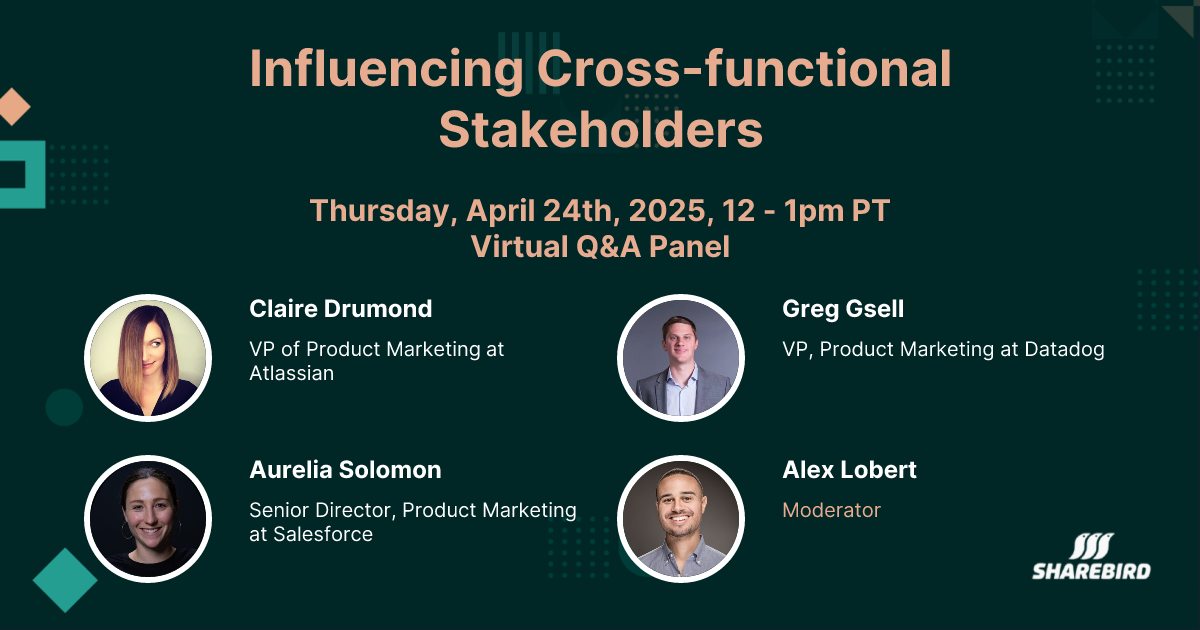
Influencing Cross-functional Stakeholders

Influencing Cross-functional Stakeholders

Thursday, April 24th, 2025 • 12pm–1pm PT ·

About Event

Join 200 product marketers to learn how PMM leaders at the fastest-growing tech companies successfully manage stakeholders to drive alignment, influence decision-making, and execute impactful go-to-market strategies. This virtual event will provide actionable insights and proven techniques to navigate cross-functional relationships, secure buy-in, and ensure marketing success. Don’t miss this opportunity to connect with industry peers and sharpen your stakeholder management skills.

Date: Thursday, April 24th, 12-1pm PT (3-4pm ET)

Location: Online (link will be sent to registrants prior to the event)
Cost: This event is free. However, seats are limited, so be sure to register early!


Top Questions

  • Do you have any tips on how to use AI to help make cross-functional alignment easier?

    Greg Gsell
    Greg Gsell

    Datadog VP, Product Marketing | Formerly Salesforce, Attentive • 1y

    AI is currently more useful for preparation and synthesis than for actual stakeholder influencing. We use AI similarly for consolidating notes and summarizing feedback. For example, we recently conducted a field survey with lots of anecdotal feedback and used AI to synthesize the results. However, I'm skeptical about AI taking over complex cross-functional planning and stakeholder negotiations anytime soon. If AI could handle complicated executive influencing sessions, we might all be out of job ...Read More

    540 Views
    Aurelia Solomon
    Aurelia Solomon

    Salesforce Senior Director, Product Marketing • 1y

    I use AI primarily as an efficiency tool rather than directly for influencing, focusing on meeting documentation and content improvement. I leverage AI to record, transcribe, and analyze conversations, whether they're with AEs about deals or gathering feedback on naming or other initiatives. I use a notebook LLM to dump transcriptions and then ask questions to extract insights. This helps me work more efficiently by quickly summarizing discussions and identifying common themes across multiple co ...Read More

    517 Views
  • How do you handle an escalation from a stakeholder who didn’t feel included?

    Greg Gsell
    Greg Gsell

    Datadog VP, Product Marketing | Formerly Salesforce, Attentive • 1y

    Your response depends on whether they actually needed to be included or just wanted to be informed about the process. First, determine if you made a mistake by not including them when they should have been part of the decision-making process, or if they just felt excluded from being informed. Regardless, you need to make it right - schedule a briefing call to bring them up to speed, hear their opinions, and incorporate their feedback where appropriate. In my experience, most people just want to ...Read More

    517 Views
  • What is the best way to make product owners trust and confide in you early on, if it's not already part of company culture?

    Aurelia Solomon
    Aurelia Solomon

    Salesforce Senior Director, Product Marketing • 1y

    To build trust with product owners, know the product deeply and bring unique customer insights to the table. My first boss in product marketing told me to 'know enough to be dangerous,' which applies at all career levels. As a product marketer, you should have a deep understanding of the product, be able to demo it, and ask questions that make product managers think differently. Equally important is bringing customer conversations and insights that product might not have access to, especially fr ...Read More

    527 Views
    Claire Drumond
    Claire Drumond

    Atlassian VP of Product Marketing • 1y

    Build trust with product leaders by recognizing they don't think about your role at the depth you assume they do, and focus on demonstrating business impact. I'm fortunate to have a product leader counterpart who was a former product marketer, but that's not always the case. A key realization is that product leaders aren't thinking about your role and craft all the time, and they don't understand it at the level of depth you might assume. Constant education about your role is essential, but not ...Read More

    524 Views
  • What's one underrated skill that everyone should focus on to be more influential?

    Aurelia Solomon
    Aurelia Solomon

    Salesforce Senior Director, Product Marketing • 1y

    Knowing when and how to say no is an underrated but critical skill for being influential. Learning to say no effectively is challenging but essential. This doesn't always mean a hard no - it might be 'not now' with an explanation of current priorities and why the timing isn't right. Sometimes, though, it is appropriate to give a firm no with proper context. This skill is particularly important in influencing because the requests we receive as product marketers typically all seem important - they ...Read More

    553 Views
    Claire Drumond
    Claire Drumond

    Atlassian VP of Product Marketing • 1y

    Public speaking is a crucial skill for product marketers that many don't prioritize enough. Public speaking - whether in front of a team of 10 or on stage at a conference - is an essential skill for product marketers that often gets overlooked. Many marketers don't prioritize developing this skill, usually because it's uncomfortable and challenging. However, the ability to communicate clearly and confidently is fundamental to our role. There are many resources and classes available to improve yo ...Read More

    832 Views
    Greg Gsell
    Greg Gsell

    Datadog VP, Product Marketing | Formerly Salesforce, Attentive • 1y

    Knowing when to say yes, especially when it builds relationship capital, is just as important as knowing when to say no. While I agree with Aurelia about the importance of saying no, I'd add that knowing when to say yes is equally valuable. Sometimes someone from another team will come to you with a request that doesn't align with your priorities or ROI targets, but you can tell they're in a tough spot. Going out of your way to help them builds relationship capital that pays dividends when you n ...Read More

    533 Views
  • When should your team escalate issues to you as a manager versus continuing to try to influence themselves?

    Claire Drumond
    Claire Drumond

    Atlassian VP of Product Marketing • 1y

    There's an important distinction between an escalation that requires action and an FYI about a potential issue. Coming too late when a problem is already serious is definitely problematic. It's helpful to distinguish between an escalation where you need something specific from your manager and an FYI about a situation that might develop into something more serious. When speaking with your manager, be clear upfront about whether you're just informing them or actually requesting assistance. This c ...Read More

    548 Views
    Greg Gsell
    Greg Gsell

    Datadog VP, Product Marketing | Formerly Salesforce, Attentive • 1y

    I want to be informed early about potential issues, even if my team is still working to resolve them independently. I completely agree that team members should try to solve problems themselves first, and often when they come to discuss an escalation, by the end of the conversation they realize they can handle it themselves. However, I want to be informed of potential issues early because the worst scenario is when a situation becomes a major problem that could have been addressed more easily wit ...Read More

    550 Views
    Claire Drumond
    Claire Drumond

    Atlassian VP of Product Marketing • 1y

    I encourage my team to solve problems themselves as much as possible before escalating, but the timing depends on their career stage. Earlier in your career, everything can feel like an escalation as you're still building relationships and understanding how businesses work. I have particular empathy for those starting out in remote or hybrid environments where face time is limited. My general advice is to empower the team to solve problems through their own networks first. If it's an issue with ...Read More

    545 Views
  • What tactical methods do you use to ensure you have influence and can drive your projects forward?

    Claire Drumond
    Claire Drumond

    Atlassian VP of Product Marketing • 1y

    I agree with Greg about having a decision-making framework and clearly identifying the final approver at the top of the page. Another framework I love for complex situations is the SCIPAB framework from Mandel Communications: Situation, Complication, Implication, Position, Action, Benefit. Even if it's just one bullet point for each section, this structure helps organize your thinking and approach. It's particularly useful for developing strategy documents because it forces you to summarize wher ...Read More

    531 Views
    Aurelia Solomon
    Aurelia Solomon

    Salesforce Senior Director, Product Marketing • 1y

    Building credibility and mutual respect is the foundation for influence. How you do this varies at different career stages - early on, it might be getting quick wins to show your value. For influencing at the executive level or in any complex meeting, I recommend two specific tactics: First, send a pre-read. Even if most executives won't look at it, those who do will come with good questions. Second, have 'meetings before the meeting' with key stakeholders to get their perspective and feedback o ...Read More

    497 Views
    Greg Gsell
    Greg Gsell

    Datadog VP, Product Marketing | Formerly Salesforce, Attentive • 1y

    One of my favorite tactical approaches is creating a decision document that clearly outlines the ask and implications. As you gather feedback, incorporate it directly into the document with attribution - for example, 'Aurelia gave this feedback, and this is the answer.' This way, when the next person in the approval chain reviews it, they can see the history and evolution of the decision process. The document becomes a single source of truth for the latest messaging, feedback, and asks. This is ...Read More

    510 Views
  • Do you change your approach to influence when you're working with different teams like product or sales? Can you give examples of how you've adapted your style?

    Claire Drumond
    Claire Drumond

    Atlassian VP of Product Marketing • 1y

    When working with executive stakeholders, the most important lesson I've learned is that they are not thinking about what you're thinking about most of the time. Always set the context and assume they don't know the background that has gotten you to this point. You've probably spent months thinking about it, but they're coming in fresh. As product marketers, we should excel at stakeholder meetings because we have the unique ability to take something complicated and distill it down to something s ...Read More

    534 Views
    Aurelia Solomon
    Aurelia Solomon

    Salesforce Senior Director, Product Marketing • 1y

    Yes, you absolutely need to tailor your approach based on who you're engaging with, whether it's internal stakeholders or external audiences. For customers, you need to understand their context - how they're using your product, what challenges they face, and what they're trying to accomplish. This pre-work ensures your engagement is relevant and tailored to their specific situation. With executives, brevity is critical - focus on the one thing you want them to walk away with, and have supporting ...Read More

    513 Views
    Greg Gsell
    Greg Gsell

    Datadog VP, Product Marketing | Formerly Salesforce, Attentive • 1y

    I agree with the points about executive context switching and the need to tailor communication. I use a pyramid structure approach to communication. Start with the one key thing at the top, then add more detail as you go down the pyramid. Depending on your audience, you can start at different points in this pyramid. When talking to someone who will do the actual work, they'll want to start from the bottom up with specific tasks. When speaking with executives, start from the top down with the key ...Read More

    479 Views
  • Can you share a moment where you or your team either successfully influenced a team or failed to, and what did you learn?

    Greg Gsell
    Greg Gsell

    Datadog VP, Product Marketing | Formerly Salesforce, Attentive • 1y

    I experienced a failure that eventually turned into success when trying to redo our company's sales deck as we moved from a single product to multi-product. Despite extensive research and feedback from the field, my initial proposal was rejected by the CEO. The key learning was about negotiation tactics in cross-functional influence. Sometimes you need to go further in your initial proposal to get back to the middle ground. We took our first iteration, which was too extreme, and worked to find a ...Read More

    520 Views
    Claire Drumond
    Claire Drumond

    Atlassian VP of Product Marketing • 1y

    My story involves a long-term effort to shift Jira's positioning to appeal to business teams, not just technical teams. For years, I saw a market trend that business teams wanted to use our product, but we were positioned as a technical tool for technical teams. The biggest lesson I learned was resilience and not giving up when you know the solution is right, even if your initial approach isn't working. I spent nearly half my tenure at Atlassian trying to solve this problem, attempting different ...Read More

    514 Views
    Aurelia Solomon
    Aurelia Solomon

    Salesforce Senior Director, Product Marketing • 1y

    I had a similar experience redoing our company narrative and pitch deck. Initially, I made the mistake of optimizing solely for the CEO's preferences, but realized this wasn't practical for the sales team who would actually be using it. The key takeaway was to always anchor back to the audience and purpose of what you're creating. When I got feedback from testing with AEs and customers that conflicted with the CEO's vision, I had to step back and remind myself who would actually be using this de ...Read More

    525 Views
  • How do you balance getting alignment from the right people and avoiding too many cooks in the kitchen?

    Greg Gsell
    Greg Gsell

    Datadog VP, Product Marketing | Formerly Salesforce, Attentive • 1y

    Start broad to build consensus, then narrow down to the decision-makers as you progress. I find it's effective to begin with a wider group to gather general feedback, then gradually focus on the specific people who need to make the final decision. The RACI models are helpful here, though sometimes you can spend more time on the RACI than the actual decision itself. When dealing with executives like a CRO, remember they typically have 2-3 trusted advisors they consult regularly. You need to influ ...Read More

    537 Views

See Event Answers

Speakers (3)

  • Claire Drumond

    Claire Drumond

    VP of Product Marketing · Atlassian

    View Profile
  • Greg Gsell

    Greg Gsell

    VP, Product Marketing · Datadog

    View Profile
  • Aurelia Solomon

    Aurelia Solomon

    Senior Director, Product Marketing · Salesforce

    View Profile