
Sharebird
All events

This event has ended!

Virtual Event
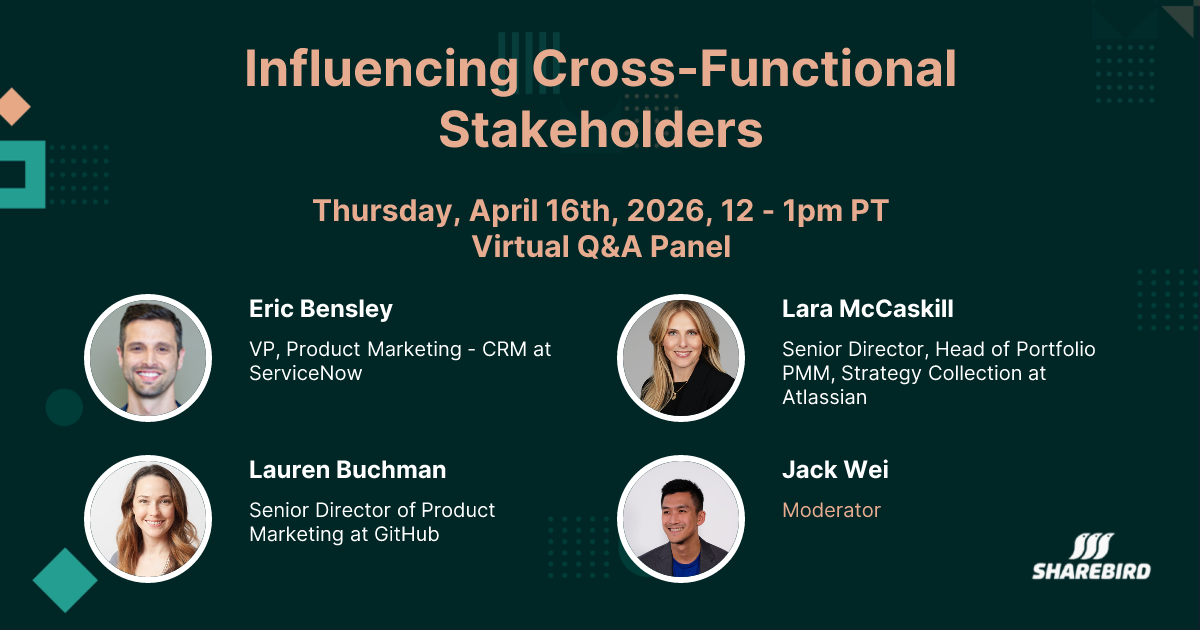
Influencing Cross-Functional Stakeholders

Influencing Cross-Functional Stakeholders

Thursday, April 16th, 2026 • 12pm–1pm PT ·

Join 150 product marketers to learn how PMM leaders at the fastest-growing tech companies successfully manage stakeholders to drive alignment, influence decision-making, and execute impactful go-to-market strategies. This virtual event will provide actionable insights and proven techniques to navigate cross-functional relationships, secure buy-in, and ensure marketing success. Don’t miss this opportunity to connect with industry peers and sharpen your stakeholder management skills.

Date: Thursday, April 16th, 12-1pm PT (3-4pm ET)

Location: Online (link will be sent to registrants prior to the event)
Cost: This event is free. However, seats are limited, so be sure to register early!


Top Questions

  • How do you signal urgency without being perceived as an 'annoyance'?

    Lara McCaskill
    Lara McCaskill

    Atlassian Senior Director, Head of Portfolio PMM, Strategy Collection | Formerly Amazon, Stitch Fix, Pandora • 2mo

    Over-communicate consistently and calibrate between informational updates and live discussions — you're only over-communicating if people explicitly tell you to stop. The bar for over-communication is simple: if no one is ever surprised by what's happening, you're doing it right. Practically: - Communicate at minimum weekly: what was done, what decisions were made, what still needs to be decided, and where you're blocked. - Think of the 'elevator pitch' — if you ran into a leader in the elevator ...Read More

    261 Views
    Lauren Buchman
    Lauren Buchman

    GitHub Senior Director of Product Marketing | Formerly Cloudflare, Google Cloud, Google Developers, Observable, Orb • 2mo

    Use visual cues like green/yellow/red status indicators and decision logs to communicate urgency clearly without requiring people to read lengthy updates. Given the pace of business today, make it easy for people to quickly understand the status of a project: - Use color-coded status indicators (green/yellow/red) in project updates. - Maintain escalation pathways and decision logs. - Lead with a 'bottom line up front' format. - Make updates easy to skim — not just frequent. This way, urgency is ...Read More

    249 Views
  • How do you build trust with other teams?

    Eric Bensley
    Eric Bensley

    ServiceNow VP, Product Marketing - CRM • 2mo

    Build trust by making people feel heard — not by always saying yes or no, but by genuinely calibrating their input and showing up authentically. Think of PMM like coaching a team: you have people with different strengths, large egos, and collaborative players. If you minimize any of them, you get less out of the end product. Trust comes from: - Making people feel heard — not agreeing with everything, but genuinely listening and calibrating. - Being authentic about your intentions to make content ...Read More

    264 Views
    Lara McCaskill
    Lara McCaskill

    Atlassian Senior Director, Head of Portfolio PMM, Strategy Collection | Formerly Amazon, Stitch Fix, Pandora • 2mo

    Build genuine interpersonal relationships by consistently connecting with partners, not just when you need something from them. Trust is the most underrated currency in cross-functional work. Practically: - Send regular messages to your partners — not just transactional asks, but genuine connection about what's going on in their day-to-day. - Deeply care about their work and challenges, not just your own agenda. - The reality is that what you need from them is rarely their top priority. Trust an ...Read More

    273 Views
  • How can we keep strong alignment when projects change their priorities or scope as you go? For instance, discovering bigger issues with GTM systems, tech or data operations that need fixing.

    Lara McCaskill
    Lara McCaskill

    Atlassian Senior Director, Head of Portfolio PMM, Strategy Collection | Formerly Amazon, Stitch Fix, Pandora • 2mo

    Over-communicate constantly, maintain regular cross-functional check-ins, and ensure decision-making accountability is always clear — especially when things change. When project priorities or scope shift: 1. **Communicate changes immediately**: As the PMM orchestrator, you're the one with full visibility. When decisions are made or things are at risk, communicate that to all relevant stakeholders right away. 2. **Clarify who owns what**: When scope changes, re-clarify who is on point for each ne ...Read More

    234 Views
  • What are some tips for influencing senior leaders?

    Lauren Buchman
    Lauren Buchman

    GitHub Senior Director of Product Marketing | Formerly Cloudflare, Google Cloud, Google Developers, Observable, Orb • 2mo

    Reframe executives as people trying to navigate their roles, and position yourself as someone who helps them succeed. The perspective on executives changes as you gain experience. Rather than seeing them as centers of power, view them as people who are trying to make the organization successful — people who have less time and context than you do. Ask yourself: how can I help them be successful in their efforts? This reframe can shake off nerves and shift your approach from seeking approval to of ...Read More

    240 Views
    Lara McCaskill
    Lara McCaskill

    Atlassian Senior Director, Head of Portfolio PMM, Strategy Collection | Formerly Amazon, Stitch Fix, Pandora • 2mo

    Understand who the ultimate decision maker is, know their motivations, and present information in a way that gives them everything they need to make a call. When an executive comes in with a strong opinion or wants to change direction: 1. Identify who the ultimate decision maker is — the executive who can swoop in and make a final call. 2. Build a strong working relationship with that person so you understand their priorities and motivations. 3. When they push for a change (e.g., launching next ...Read More

    250 Views
  • What are the best ways to influence those you don't have authority over?

    Lara McCaskill
    Lara McCaskill

    Atlassian Senior Director, Head of Portfolio PMM, Strategy Collection | Formerly Amazon, Stitch Fix, Pandora • 2mo

    Data is table stakes, but understanding the motivation behind your cross-functional partner's feedback is equally important for knowing how to respond. Always have a strong understanding of the data that backs up your position. Beyond that, take time to understand where your cross-functional partner is coming from. For example, if a sales rep is pushing back on messaging, ask yourself: is this coming from recency bias — a single customer conversation that may be an outlier? If so, maybe they don ...Read More

    233 Views
    Eric Bensley
    Eric Bensley

    ServiceNow VP, Product Marketing - CRM • 2mo

    Use multiple 'currencies' — intuition/logic, customer evidence, and options — to influence stakeholders when you don't have decision-making power. As a PMM, you have several currencies available when you can't simply say no or override a decision: 1. **Intuitive storytelling**: Make your angle make more sense than the alternative. If you can communicate visually and logically in a way that lands with someone, that's a powerful currency. 2. **Customer evidence**: No one can argue with customers. ...Read More

    249 Views
  • What’s your favorite framework for identifying the 'hidden currency'—what those stakeholders actually value—to make the 'ask' feel like a win for them rather than a chore for me?

    Eric Bensley
    Eric Bensley

    ServiceNow VP, Product Marketing - CRM • 2mo

    Show stakeholders something concrete and observe their reaction — people reveal what they truly care about when responding to real work, not broad questions. The currency of individuals is very personal, and broad coffee chats or open-ended questions like 'what's important to you this year?' rarely surface true priorities — people are busy, guarded, and behave differently in different settings. A more effective approach: 1. **Show, don't ask**: Create an MVP or early version of something — a pro ...Read More

    257 Views
  • How do you coordinate multiple stakeholders with different visions on the product messaging?

    Lara McCaskill
    Lara McCaskill

    Atlassian Senior Director, Head of Portfolio PMM, Strategy Collection | Formerly Amazon, Stitch Fix, Pandora • 2mo

    Validate messaging with customers, bring stakeholders along on the journey so they feel heard and bought in, and treat the narrative as a living document that evolves over time. Narrative and messaging is one of the harder aspects of PMM because it's subjective and everyone has opinions. Key approaches: 1. **Validate with customers**: Use customer feedback to ground the messaging in reality and depersonalize debates. 2. **Bring stakeholders along**: Make sure they feel heard throughout the proce ...Read More

    251 Views
  • In Dev-led company, how do you influence development teams that traditionally worked in silos and are resistant to product management / product marketing?

    Lauren Buchman
    Lauren Buchman

    GitHub Senior Director of Product Marketing | Formerly Cloudflare, Google Cloud, Google Developers, Observable, Orb • 2mo

    Find the teams that want to be successful, make them successful, and let those wins attract others — don't try to win everyone over at once. In engineering-driven organizations, resistance to PMM is common. Rather than forcing your way in: 1. **Find willing partners**: Identify the teams and individuals who are open to collaboration and want to be successful. 2. **Make them successful**: Focus your energy there and deliver real results. 3. **Tout those wins**: Share the outcomes broadly so other ...Read More

    251 Views
    Eric Bensley
    Eric Bensley

    ServiceNow VP, Product Marketing - CRM • 2mo

    Ensure there is strategic executive sponsorship for PMM's involvement, and if a team is resistant and there's no sponsorship, redirect your energy to where you can have impact. When PMM is hitting a wall with a resistant team: 1. **Check for strategic sponsorship**: Is there an executive who believes PMM should be in this work stream? Without that, you're pushing uphill. 2. **Understand your three bosses**: In PMM, you effectively have a CMO, a head of product, and a head of sales. On any given ...Read More

    240 Views
  • Are there any books or resources about influence that you would recommend?

    Lara McCaskill
    Lara McCaskill

    Atlassian Senior Director, Head of Portfolio PMM, Strategy Collection | Formerly Amazon, Stitch Fix, Pandora • 2mo

    Dale Carnegie's 'How to Win Friends and Influence People' is a classic starting point for understanding influence.

    'How to Win Friends and Influence People' by Dale Carnegie is a timeless resource on influence and interpersonal relationships. While it's not PMM-specific, the principles of building genuine connections, understanding what others care about, and communicating in ways that resonate are directly applicable to the cross-functional influence challenges PMMs face every day.
    239 Views
    Jack Wei
    Jack Wei

    Sendbird fmr Head of Marketing | Formerly SmartRecruiters, Mixpanel, Deloitte, Beardwood&Co • 2mo

    StrengthsFinder is a valuable resource because it helps you understand and double down on your authentic strengths, which is foundational to genuine influence. Because PMM is so broad and influence is so personal, there's no single PMM-specific book on the topic. StrengthsFinder is recommended because: 1. **Know your strengths**: PMM touches so many things — it's a balance of soft and hard skills. Understanding what you're genuinely good at helps you influence more authentically. 2. **Double dow ...Read More

    258 Views
  • How do you track and prove something you've influenced as a product marketer?

    Lauren Buchman
    Lauren Buchman

    GitHub Senior Director of Product Marketing | Formerly Cloudflare, Google Cloud, Google Developers, Observable, Orb • 2mo

    Track message pull-through — you've nailed it when executives are saying your phrases naturally, thinking it was their own idea, and when those messages show up in sales conversations and on stage. Proving narrative influence is difficult, but here are practical approaches: 1. **Message pull-through tracking**: Create a list of specific quotes, phrases, or taglines you want to see reflected in materials and conversations. You know you've succeeded when executives are saying them naturally — and ...Read More

    252 Views
  • How do you influence or convince stakeholders who prefer to consult AI more than product marketing?

    Lara McCaskill
    Lara McCaskill

    Atlassian Senior Director, Head of Portfolio PMM, Strategy Collection | Formerly Amazon, Stitch Fix, Pandora • 2mo

    Treat AI-generated work as a starting point and a conversation starter, not a threat — partner with stakeholders on what they've built. If a stakeholder in product has used AI to work on messaging, that's actually an opportunity: - Welcome it: 'I'd love to partner with you on that and see what you've started.' - AI output is a thought starter and a place to begin a conversation — it's not the end-all be-all. - Use it as a foundation to review, refine, and elevate together. - This approach positi ...Read More

    236 Views
    Eric Bensley
    Eric Bensley

    ServiceNow VP, Product Marketing - CRM • 2mo

    Don't fight it — give stakeholders a better version of AI that's grounded in your PMM knowledge, such as synthetic personas built on your research. You can't tell people you're smarter than AI — everyone is asking AI questions, and that's not going to change. Instead: 1. **Offer a better AI alternative**: At ServiceNow, the team has built synthetic personas — essentially Claude projects grounded in persona studies and research — that look and feel like the AI stakeholders already use, but are in ...Read More

    251 Views
    Lauren Buchman
    Lauren Buchman

    GitHub Senior Director of Product Marketing | Formerly Cloudflare, Google Cloud, Google Developers, Observable, Orb • 2mo

    Lean into AI by creating PMM-informed bots and context windows that scale your team's expertise and make it accessible to stakeholders. At GitHub, the team has gone beyond synthetic personas to create synthetic PMM bots — AI agents modeled on specific team members with particular craft strengths. For example, an 'Ask an Eric' bot that captures a team member's writing craft. Key approaches: - Create markdown files and context windows that feed into these AI tools so stakeholders can access the sa ...Read More

    249 Views
  • What is the most underrated skill for influencing stakeholders as a PMM?

    Lara McCaskill
    Lara McCaskill

    Atlassian Senior Director, Head of Portfolio PMM, Strategy Collection | Formerly Amazon, Stitch Fix, Pandora • 2mo

    Building trust — because the things you need from cross-functional partners are rarely their top priority, and trust is what gets them done. Building genuine interpersonal relationships with your cross-functional partners is the most underrated skill. It's not just about saying hi — it's about deeply connecting and caring about what's going on in their day-to-day. The reality is: you constantly need things from people for whom those things are not a top priority. Trust and partnership are what m ...Read More

    238 Views
    Lauren Buchman
    Lauren Buchman

    GitHub Senior Director of Product Marketing | Formerly Cloudflare, Google Cloud, Google Developers, Observable, Orb • 2mo

    Knowing whether you're having a 'feelings' or a 'data' conversation — reading the actual conversation you're in, not just the agenda. The underrated skill is being able to read the room and understand what kind of conversation you're actually having: - Is this person speaking in data, or do they want to talk in anecdotes and emotional truth? - Are they venting, or are they genuinely looking for input? - Is this a listening session, or a decision-making meeting? Being able to distinguish these in ...Read More

    242 Views
    Eric Bensley
    Eric Bensley

    ServiceNow VP, Product Marketing - CRM • 2mo

    Self-awareness — knowing how you come across and how your words and work impact others. Self-awareness is a skill you can't always teach, and it's foundational to building trust. People need to know that you understand how you come across, how your words land, and how your work affects others. Without self-awareness, even well-intentioned influence can backfire. It's what allows you to calibrate your approach, know when to push and when to listen, and build the kind of authentic relationships th ...Read More

    249 Views
  • How do you know when a narrative needs to change versus when the problem is just inconsistent execution of a great message?

    Lara McCaskill
    Lara McCaskill

    Atlassian Senior Director, Head of Portfolio PMM, Strategy Collection | Formerly Amazon, Stitch Fix, Pandora • 2mo

    Monitor customer feedback and sales team signals for staleness, and watch for collateral sprawl as a sign of inconsistent execution rather than a need for a new narrative. Two distinct signals to watch for: 1. **Narrative staleness**: If customer feedback and sales conversations suggest the message isn't resonating or feels outdated, it may be time to refresh the narrative. 2. **Inconsistent execution**: If you're seeing pitch and collateral sprawl — people creating their own versions of materia ...Read More

    247 Views
  • On product launches, how do you handle a situation where a PM is convinced a launch is ready but you, as the commercial lead, know the market story and prep work isn't ready?

    Lauren Buchman
    Lauren Buchman

    GitHub Senior Director of Product Marketing | Formerly Cloudflare, Google Cloud, Google Developers, Observable, Orb • 2mo

    Ground your feedback in objective, measurable launch readiness criteria — and pair the tough feedback with a compelling vision of what a great launch could look like. When you have to tell a PM their launch isn't ready, remember it's their 'baby' — you're essentially telling them it's not ready for the world. To deliver this constructively: 1. **Get grounded in objective criteria**: Use measurable standards for launch readiness, not personal opinions. 2. **Product quality**: If features are lack ...Read More

    244 Views
  • What experience made you come to terms with PMM influencing a lot but controlling very little, and did it shift the way you operate and work with cross-functional stakeholders?

    Lauren Buchman
    Lauren Buchman

    GitHub Senior Director of Product Marketing | Formerly Cloudflare, Google Cloud, Google Developers, Observable, Orb • 2mo

    Listening and gathering context is key — when everyone has access to the same information, they tend to come to the same conclusions. PMM has an opportunity to push people toward better outcomes by helping them see beyond linear thinking. As an early marketing hire at Cloudflare, there were two competing priorities: one focused on a technology that would benefit the broader internet ecosystem (securing HTTPS/SSL), and another that was more commercially viable (SSL certs for SaaS companies). The ...Read More

    236 Views
  • what if product and engineering teams are used to working in silos and think the PMM function is a cost center??

    Jack Wei
    Jack Wei

    Sendbird fmr Head of Marketing | Formerly SmartRecruiters, Mixpanel, Deloitte, Beardwood&Co • 2mo

    Choose one front at a time, set clear expectations about your order of operations, and build credibility in one area before expanding to others. When you're the first PMM or working in an organization that doesn't yet see PMM's value: 1. **Don't fight all battles at once**: Choose one cross-functional front to focus on first. 2. **Align to the company's main objective**: For example, if the company is trying to move upmarket, make that your first priority — create the enterprise-facing story, en ...Read More

    228 Views
  • How to implement new positioning and messaging- so all the teams will adapt it quickly?

    Lara McCaskill
    Lara McCaskill

    Atlassian Senior Director, Head of Portfolio PMM, Strategy Collection | Formerly Amazon, Stitch Fix, Pandora • 2mo

    Run a roadshow to get everyone on the same page, ensure they have the right collateral, and address collateral sprawl proactively as a signal of inconsistent execution. When rolling out new positioning and messaging: 1. **Identify the signal**: If you're seeing pitch and collateral sprawl — people making their own versions of materials — that's a clear sign of inconsistent execution. 2. **Run a roadshow**: Bring all relevant teams together to align on the core message. Make sure everyone truly u ...Read More

    225 Views
  • What's your best advice for influencing without authority?

    Eric Bensley
    Eric Bensley

    ServiceNow VP, Product Marketing - CRM • 2mo

    Leadership is influence, not ownership. Be an opinion people want, not one they're forced to get. PMM not owning much of anything is actually what makes the role great. The best leaders push teams to do things because those teams feel compelled to act — not because they're told to. Strive to be an opinion that people seek out, not just a checkbox on a RACI. This means: - Show up authentically with the intent to make content and outcomes better. - Get hands-on and work alongside teams. - Don't ad ...Read More

    245 Views
  • What are the best ways to influence without authority?

    Lauren Buchman
    Lauren Buchman

    GitHub Senior Director of Product Marketing | Formerly Cloudflare, Google Cloud, Google Developers, Observable, Orb • 2mo

    Build trust, find the right executive sponsorship, and focus your energy where you're explicitly welcomed and can make an impact. In engineering-driven organizations, not every team will immediately see the value of PMM. Rather than trying to win everyone over at once: - Find the teams and individuals who want to be successful and work with them. - Make them successful and tout those wins. - Other teams will want to be part of what you're making happen — the right folks will follow. - If executi ...Read More

    256 Views
    Eric Bensley
    Eric Bensley

    ServiceNow VP, Product Marketing - CRM • 2mo

    Use customer evidence, intuitive logic, and options as your currencies when you lack formal authority. When you're not the decision maker, you still have powerful tools: 1. **Intuitive communication**: Make your perspective make more logical sense than the alternative. If you can present something visually and clearly that resonates, that's a real currency. 2. **Customer validation**: Bring conflicting feedback to a group of friendly customers. Present both versions and let their responses guide ...Read More

    247 Views
  • What are the best practices and strategies to align cross-functional stakeholders? Please also provide examples.

    Lara McCaskill
    Lara McCaskill

    Atlassian Senior Director, Head of Portfolio PMM, Strategy Collection | Formerly Amazon, Stitch Fix, Pandora • 2mo

    Managing expectations through consistent over-communication, a tiering framework, and regular cross-functional check-ins is the foundation of keeping stakeholders aligned across a launch. Key practices include: 1. **Tiering framework at kickoff**: When you bring all stakeholders together to kick off a product launch, use a tiering framework so everyone understands the scope and who is accountable for each part. 2. **Over-communicate constantly**: As the PMM, you're the orchestrator — you have vi ...Read More

    239 Views
    Lauren Buchman
    Lauren Buchman

    GitHub Senior Director of Product Marketing | Formerly Cloudflare, Google Cloud, Google Developers, Observable, Orb • 2mo

    Adopt a 'no surprises' North Star for your PMM team, and use visual cues to make updates easy to skim and act on. A strong PMM team charter should aim for no surprises — no one should ever be caught off guard by what PMM is doing, whether that's executives, ICs, or cross-functional departments. To support this: - Use green/yellow/red status indicators in project updates so people can orient quickly without reading everything. - Maintain decision logs and escalation pathways. - Lead with a 'botto ...Read More

    262 Views

See Event Answers

Speakers (3)

  • Eric Bensley

    Eric Bensley

    VP, Product Marketing - CRM · ServiceNow

    View Profile
  • Lara McCaskill

    Lara McCaskill

    Senior Director, Head of Portfolio PMM, Strategy Collection · Atlassian

    View Profile
  • Lauren Buchman

    Lauren Buchman

    Senior Director of Product Marketing · GitHub

    View Profile