
Sharebird
All events

This event has ended!

Virtual Event
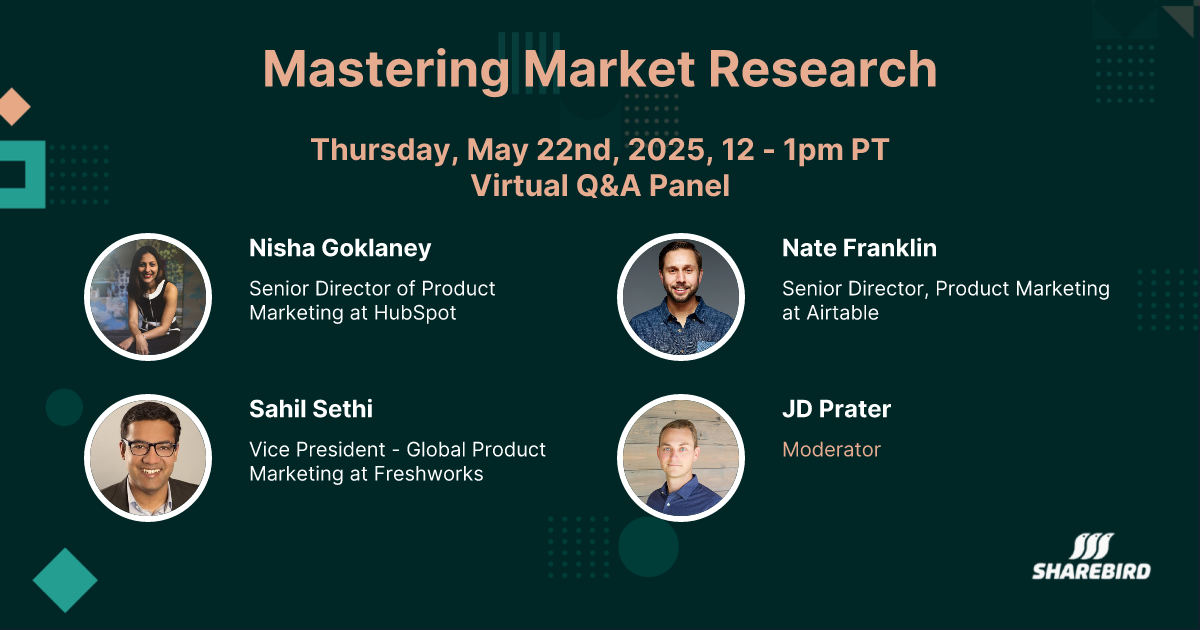
Mastering Market Research

Mastering Market Research

Thursday, May 22nd, 2025 • 12pm–1pm PT ·

Join over 200+ product marketers to learn how PMM leaders at the fastest-growing tech companies leverage market research to drive strategic decisions, refine messaging, and execute high-impact go-to-market strategies.

This virtual event will provide actionable insights and proven techniques to gather, analyze, and apply market research effectively. Learn how to extract meaningful customer and competitor insights, influence key stakeholders with data-driven storytelling, and ensure your marketing efforts are backed by research-driven decisions.

Date: Thursday, May 22nd, 12–1 PM PT (3–4 PM ET)
Location: Online (link will be sent to registrants prior to the event)
Cost: Free—but seats are limited, so be sure to register early!


Top Questions

  • How do you keep up with market intelligence with a busy schedule?

    JD Prater
    JD Prater

    Ting VP of Marketing • 1y

    I maintain a carefully curated LinkedIn feed focused on my industry, customers, and competitors. LinkedIn is my go-to source for market intelligence when I'm busy. I've intentionally curated my feed to follow my customers, competitors, and other relevant industry professionals rather than just personal connections. This way, whenever I need a quick context switch or have a few minutes between meetings, I can scroll through LinkedIn and absorb market intelligence passively. It's an efficient way ...Read More

    362 Views
    Sahil Sethi
    Sahil Sethi

    Freshworks Vice President - Global Product Marketing | Formerly Klaviyo, Qualtrics, Microsoft, MckInsey • 1y

    I focus on customer trends over real-time market intelligence, using a curated LinkedIn feed and targeted research. A curated LinkedIn feed is indeed the single biggest way to get an idea of what's happening in the market. Alerts and deep research using AI tools are also very useful, especially when you prompt them correctly or point them to specific websites. However, I think many of us are overly obsessed with real-time market and competitor intelligence. What matters more is understanding cus ...Read More

    522 Views
    Nate Franklin
    Nate Franklin

    Airtable Senior Director, Product Marketing • 1y

    I use AI to conduct regular web searches on key topics and track changes over time. I regularly ask ChatGPT to do web searches for me on specific topics, typically once a week. While I haven't yet set up fully automated monitoring, I use the same prompt each week to search for relevant information and can easily see what's changed since the previous search. This approach allows me to efficiently track market developments without spending hours manually searching for updates. The goal is eventual ...Read More

    432 Views
    Nisha Goklaney
    Nisha Goklaney

    HubSpot Senior Director of Product Marketing | Formerly Intuit, American Express, Sage • 1y

    I rely on alerts and curated newsletters, dedicating early morning hours to focused market intelligence review. I set up alerts for key topics and subscribe to specific newsletters that I trust to keep me informed about market developments. I carve out dedicated time for deep work, usually very early in the morning before my kids wake up, to review this information and stay current. It's important to be realistic - with markets changing so quickly, it's impossible to know everything about every ...Read More

    698 Views
  • How will a PMM’s research differ from a PM’s?

    Sahil Sethi
    Sahil Sethi

    Freshworks Vice President - Global Product Marketing | Formerly Klaviyo, Qualtrics, Microsoft, MckInsey • 1y

    The research itself isn't different - both roles need the same inputs but use them for different outputs. A PM needs to know the customer, market, and product in order to build great products. A PMM needs to know the same things but uses that knowledge to commercialize those products. It's like two chefs using the same ingredients but making completely different recipes. Great PMs rely on market and customer insights, and great PMMs rely on the same insights - we share tools, insights, and conve ...Read More

    398 Views
    Nisha Goklaney
    Nisha Goklaney

    HubSpot Senior Director of Product Marketing | Formerly Intuit, American Express, Sage • 1y

    The inputs might be the same, but the outputs and timing differ between PM and PMM research. A PM might be doing research to inform the product roadmap, while we as PMMs are usually researching to inform what resonates in market messaging, the selling story, and how to connect with customers. We put products in front of customers to understand how they're using it, what pain it's solving, how they were addressing this need before, and why they're choosing us versus competitors like Zendesk or Sa ...Read More

    384 Views
    Nate Franklin
    Nate Franklin

    Airtable Senior Director, Product Marketing • 1y

    While the research is largely the same, there's some specialization in focus - PMs should specialize in users while PMMs focus more on buyers. I agree that if you're not sharing research with your PMs and vice versa, that's the first problem to solve - you should be on the same page with the same picture of the world. However, there is some specialization: I would expect my PM to know more about how someone will actually use and build with our product (in my case, Airtable), while I'll understan ...Read More

    391 Views
  • Given that your research can come from many different sources, stored in many different tools and can take many different forms. How do you go about organizing, managing and sharing your findings?

    Nisha Goklaney
    Nisha Goklaney

    HubSpot Senior Director of Product Marketing | Formerly Intuit, American Express, Sage • 1y

    We use a multi-channel approach to organize and share research at Hubspot, with seismic as our central repository for all buyer and seller collateral and enablement content. We house all our research in seismic as our single source of truth, including demos from sales specialists and GMs that help reps learn about products and features. We also distribute insights through bi-weekly newsletters that about half the company subscribes to, and we maintain a dedicated competitive slack channel where ...Read More

    412 Views
    Nate Franklin
    Nate Franklin

    Airtable Senior Director, Product Marketing • 1y

    At Airtable, we organize research based on who the ultimate consumer of the information will be and how they'll use it. We think about the ultimate consumer of the research and what they need. For sales, we focus on insights that help them understand customer problems and resonate with prospects when entering a customer conversation, industry, or vertical. For our product team, we organize research that helps them build product requirement docs that relate to what buyers are thinking about in th ...Read More

    379 Views
    Sahil Sethi
    Sahil Sethi

    Freshworks Vice President - Global Product Marketing | Formerly Klaviyo, Qualtrics, Microsoft, MckInsey • 1y

    We organize research by first distinguishing between different types: customer research, brand research, and general market research, as they serve different purposes and have different scopes. Customer research focuses on your existing customers but is limited to that base, market research targets prospects and the general market to understand reactions to value propositions, and brand research polls the entire market for brand awareness and perception. We organize our research based on these c ...Read More

    387 Views
    JD Prater
    JD Prater

    Ting VP of Marketing • 1y

    I apply a very Occam’s-razor rule to market research ops: use the simplest system that still makes the insights searchable, up-to-date, and easy to broadcast. Here's the workflow we've built: First, I create a single “home base.” For us that’s an Airtable; a Google Sheet works fine at smaller scale. Every data point—win-loss quote, usability clip, analyst stat—lands here as a row with fields for source, date, persona, JTBD, and a link to the raw artifact (recording, PDF, Tweet, whatever). One ba ...Read More

    391 Views
  • What types of launches do you do market research for?

    JD Prater
    JD Prater

    Ting VP of Marketing • 1y

    I lean on market research for every launch, but I never assume we have to start from scratch. First stop is the shared intel repository—usage logs, win-loss notes, usability clips, analyst snippets, social posts. If that evidence answers the core questions, great. If it exposes blind spots, then I commission fresh research matched to the size of the bet. Net-new products or entries into a new category. These moves usually reveal big gaps in the repo—no customer language, no clear decision criter ...Read More

    402 Views
  • What are the best way(s) to do competitive research in the enterprise space when features and pricing are not as transparent?

    JD Prater
    JD Prater

    Ting VP of Marketing • 1y

    The lack of sticker prices and public roadmaps in enterprise software turns “competitive research” into a bit of a scavenger hunt—but you don’t have to don a trench coat. I start with the richest source: buyers who just finished evaluating vendors. In debriefs with both won and lost prospects, AEs often get forwarded SOWs, red-lined MSAs, or at least a verbal rundown of discount tiers and usage-based add-ons. Those artifacts reveal real street pricing and which features pop onto the invoice only ...Read More

    381 Views
  • How much time/resources do you spend on research when the launch target date is too close or timeline is aggressive?

    JD Prater
    JD Prater

    Ting VP of Marketing • 1y

    When a launch date is barreling toward us, I don’t skip research—I compress it. First, I map every open question (messaging resonance, pricing, must-have features, likely objections) and score each one on a simple Risk × Impact × Effort matrix. Anything that scores high on both risk and impact but can be answered with modest effort gets my attention; the rest becomes “post-launch learning.” This triage usually pares the list to two or three critical unknowns, which I tackle in a “lean research s ...Read More

    2,472 Views
  • As a PMM, do you share a market research knowledge base with PM’s? How are you addressing the overlap in market research needs between the two functions?

    JD Prater
    JD Prater

    Ting VP of Marketing • 1y

    Absolutely—market research should live in a single, neutral repository that both PM and PMM treat as their “source of truth.” Whether you stand it up in Airtable, a spreadsheet, or a purpose-built platform, the goal is one table where all market intelligence—competitive teardowns, customer interviews, analyst forecasts, social listening snippets—gets logged with identical light-weight fields (source, persona, date, confidence score, link to the raw artifact). When every fact sits side-by-side, d ...Read More

    392 Views
  • What's one essential qualitative research method you recommend entry-level PMMs learn?

    JD Prater
    JD Prater

    Ting VP of Marketing • 1y

    If I could hand every new PMM one qualitative super-power, it’d be the think-aloud usability walkthrough. Invite a real user, give them a single everyday task (“spin up a streaming key and transcribe a file”), and ask them to narrate every thought as they click. You sit back, say nothing, and let the friction surface itself: hesitation on a button, a muttered “wait—do I pay extra for this?”, or a copy-and-paste from docs that proves the UI isn’t doing its job. I run these in four fast moves: Rec ...Read More

    420 Views
  • When you're new at a company, how do you determine the most critical area for initial market research?

    Nisha Goklaney
    Nisha Goklaney

    HubSpot Senior Director of Product Marketing | Formerly Intuit, American Express, Sage • 1y

    Use AI to analyze customer calls and identify patterns that can inform your content strategy. Take those recorded customer calls, feed them into Claude or ChatGPT, and extract patterns and insights. The AI can identify common themes like what questions every CIO asks or what concerns they consistently raise. You can then use these insights to create targeted sales enablement materials or blog articles that address these specific points, which also helps with SEO. This approach turns existing cus ...Read More

    672 Views
    JD Prater
    JD Prater

    Ting VP of Marketing • 1y

    Use LinkedIn as a free market research tool by following your customers, competitors, and industry influencers. One free approach I use is turning LinkedIn into my market research feed by following my customers, competitors, and other PMMs to see what they're talking about and what excites them. This helps me understand who the influencers are in the ecosystem, which I can then leverage for future marketing initiatives. By following the right people, I discover valuable newsletters and eventuall ...Read More

    428 Views
    Nisha Goklaney
    Nisha Goklaney

    HubSpot Senior Director of Product Marketing | Formerly Intuit, American Express, Sage • 1y

    Focus on what you don't know, starting with fundamental questions about your customers and why they choose you. When joining a company, the question isn't what research to do first, but rather what critical information you're missing. As you talk to people across the organization, ask: Who is your customer? If you ask five people across the company, will they give you the same answer? Why are you winning with the customers you're winning with? Start with these fundamental questions. Before launc ...Read More

    400 Views
    Sahil Sethi
    Sahil Sethi

    Freshworks Vice President - Global Product Marketing | Formerly Klaviyo, Qualtrics, Microsoft, MckInsey • 1y

    If you don't know where to start, begin with customer research and then identify what's hindering your go-to-market efforts. Start by understanding your audience - their pain points, daily challenges, the words they use, the problems they describe, and the KPIs they're measured on. Focus on what makes their careers successful and what might get them fired. In many companies, we sell to buying committees with different roles (economic buyer, champion, end user, administrator), so understanding ea ...Read More

    408 Views
    Sahil Sethi
    Sahil Sethi

    Freshworks Vice President - Global Product Marketing | Formerly Klaviyo, Qualtrics, Microsoft, MckInsey • 1y

    Leverage call recording tools like Gong to quickly understand your customers' perspectives. Tools like Gong and Outreach are incredibly powerful for understanding your customers. When I started my product marketing career 15 years ago at Microsoft, we had to beg sales reps to let us be a fly on the wall in customer meetings - that was the only way to truly understand what customers were thinking. Reading persona cards isn't enough; you need to hear customers expressing their pain points directly ...Read More

    410 Views
    Nate Franklin
    Nate Franklin

    Airtable Senior Director, Product Marketing • 1y

    Start by understanding your audience - that's the foundation for everything else you'll do as a product marketer. As a product marketer, your most important task is understanding your audience. I think of it as a hierarchy: do we have information that helps me understand my audience well enough to form opinions about what keeps them up at night, what they're thinking about, what their big focus areas are, and what gets them hired, promoted, or fired? If you can't answer these questions, you need ...Read More

    452 Views
  • What's your criteria for deciding to do DIY research versus bringing in outside researchers?

    Nisha Goklaney
    Nisha Goklaney

    HubSpot Senior Director of Product Marketing | Formerly Intuit, American Express, Sage • 1y

    We follow an 80/20 rule - 80% DIY and 20% external for strategically significant research. At Hubspot, we use external agencies for research that will drive fundamental, company-wide strategic decisions. For example, when we were evaluating what Hubspot wanted to stand for and win on for the next three years - which became our 'easy, fast, and unified' positioning that now guides 8,000+ employees and our entire product roadmap - we used external research. Similarly, when determining how to price ...Read More

    408 Views
    Sahil Sethi
    Sahil Sethi

    Freshworks Vice President - Global Product Marketing | Formerly Klaviyo, Qualtrics, Microsoft, MckInsey • 1y

    We primarily outsource our research because we believe conducting research is not our core competency. Every company has a different philosophy on this. At Freshworks, we've chosen to focus on our strengths and let research experts handle what they do best. We work with large agencies, small agencies, and freelancers for discrete use cases like message testing and brand research. Even for customer insights, we use a hybrid model with some DIY and some agency support. This approach works well for ...Read More

    386 Views
    Nate Franklin
    Nate Franklin

    Airtable Senior Director, Product Marketing • 1y

    The decision depends on scale, impact, and available budget - we primarily do DIY but are increasing our use of agencies. At Airtable, we're still a relatively small startup, so we've historically done more DIY research. However, we're starting to use more agency support as we grow. I think about this decision based on scale and potential impact - how much will the research affect your business? A brand report might be something we'd try to run ourselves at our current size, but at a larger comp ...Read More

    383 Views
  • What systems have you automated with AI for research on an ongoing basis?

    Nisha Goklaney
    Nisha Goklaney

    HubSpot Senior Director of Product Marketing | Formerly Intuit, American Express, Sage • 1y

    We've focused our automation on competitive intelligence gathering and analysis. We have an agent that collates competitive intelligence for us, which isn't groundbreaking but is very helpful given the volume of information available. This agent helps us keep our finger on the pulse regarding competitors' pricing, packaging, and messaging. We've also put all our messaging, product positioning, and win/loss information into Claude projects, which helps when someone from our team is preparing for ...Read More

    377 Views
    Nate Franklin
    Nate Franklin

    Airtable Senior Director, Product Marketing • 1y

    We've automated the collection and analysis of customer feedback from multiple sources using AI in Airtable. We dump all our Gong calls into Airtable, along with feedback from Slack and our customer community. Our AI inside Airtable runs on this data, categorizing it, pulling out snippets, formatting it, and creating different views for product people versus marketers. We don't have a view for sales yet, but it's something we're considering. This automation does a huge amount of work to consolid ...Read More

    380 Views
    JD Prater
    JD Prater

    Ting VP of Marketing • 1y

    We've automated the synthesis of internal customer data from multiple sources into actionable insights. We've done a good job automating the analysis of internal data sources like sales calls and customer support tickets. We use Pylon, an AI-first customer support tool that allows me to prompt it with a specific use case I'm looking for, and it will identify relevant customers - essentially reverse engineering the research process. Instead of trying to find the right customer, I can specify the ...Read More

    398 Views
    Sahil Sethi
    Sahil Sethi

    Freshworks Vice President - Global Product Marketing | Formerly Klaviyo, Qualtrics, Microsoft, MckInsey • 1y

    We're in the early stages of AI automation for research, focusing on a custom GPT for marketing.

    We're currently rolling out a custom GPT for all marketing that we're feeding with our tone and voice guidelines, but I wouldn't call that full automation. For market research specifically, we rely on competitive intelligence use cases but haven't yet implemented full synthesis of all data to automatically generate reports. That may be our next step, but we're not there yet.
    388 Views
  • How do you create and deliver research findings in formats that will actually be consumed by your audience?

    Nate Franklin
    Nate Franklin

    Airtable Senior Director, Product Marketing • 1y

    Repetition is crucial, especially for sales teams who are juggling hundreds of accounts and need information when it's relevant to them. I love my sellers, but I know I have to tell them something 10 times for it to actually sink in. This isn't a criticism - it's because they're managing hundreds of accounts, especially in mid-market or lower segments. You have to find ways to make information last and resonate. Storytelling and emphasizing the 'so what' is critical. One effective approach we've ...Read More

    357 Views
    Nisha Goklaney
    Nisha Goklaney

    HubSpot Senior Director of Product Marketing | Formerly Intuit, American Express, Sage • 1y

    Provide information at the moment of need and leverage customer stories to make research findings more compelling. Sales enablement sessions are standard, but unless the information is top of mind or relevant to an active sales cycle, much of it gets lost. Our Slack channels and AI tools have been helpful because reps can just ask questions to our 'Sales GPT' and get immediate answers. We're also doubling down on customer testimonial stories, especially for new technologies like AI where we have ...Read More

    369 Views
    Sahil Sethi
    Sahil Sethi

    Freshworks Vice President - Global Product Marketing | Formerly Klaviyo, Qualtrics, Microsoft, MckInsey • 1y

    There's no single solution to information delivery - the key is using multiple channels with great storytelling and repetition. We're all inundated with too much information at work across Slack, Teams, SharePoint, Seismic, Highspot and other tools. My approach is to use all available channels because cognition and retention requires repetition. The answer lies in synthesis (don't dump too much information), clear and simple presentation, good storytelling, and repetition across multiple formats ...Read More

    388 Views
    JD Prater
    JD Prater

    Ting VP of Marketing • 1y

    Make your enablement meetings engaging with creative elements to capture attention. I make my enablement meetings engaging by incorporating gifts, visual elements, and interactive components like quizzes and calling on people randomly. This approach is especially important for remote teams where people might be distracted or multitasking. Creating a novel, interactive experience helps cut through the information overload and ensures people are actually paying attention to the research findings y ...Read More

    400 Views
  • How are you using AI to conduct market research?

    JD Prater
    JD Prater

    Ting VP of Marketing • 1y

    I recommend trying Google's Notebook LM, which allows you to input multiple diverse sources for comprehensive research analysis. With Notebook LM, you can give it up to 30 different sources including YouTube videos, blog announcements, hour-long webinars, and market research reports from analysts like Forrester. Once you've loaded all these sources, you can ask it to put together a brief or other content, and it synthesizes across all those inputs. The tool even has podcast-like voices that make ...Read More

    405 Views
    Nisha Goklaney
    Nisha Goklaney

    HubSpot Senior Director of Product Marketing | Formerly Intuit, American Express, Sage • 1y

    We use AI to accelerate research processes and extract deeper insights from our existing data. AI tools like ChatGPT and Claude help us quickly research competitive information - for example, when we were looking at introducing usage-based billing for our AI products, we used AI to quickly compile information on competitors' pricing models and present it in a simple table format, saving significant manual research time. We also use AI to analyze customer conversations by taking transcriptions an ...Read More

    395 Views
    Sahil Sethi
    Sahil Sethi

    Freshworks Vice President - Global Product Marketing | Formerly Klaviyo, Qualtrics, Microsoft, MckInsey • 1y

    We follow a philosophy of doing what we're good at and relying on experts for what they're good at, including AI-powered market research. Instead of building AI-based market research techniques in-house, we work with agencies and vendors who are incorporating AI into their research methodologies. When we work with agencies for brand tracking or message testing, we ask them how they're driving efficiency through AI - whether they're cleaning up responses, finding better samples, or using AI for a ...Read More

    382 Views
    Nate Franklin
    Nate Franklin

    Airtable Senior Director, Product Marketing • 1y

    You should start with one of the LLMs when thinking about research, as it's a great use case for AI, but understand its limitations. I use AI for market research every single day at varying levels - whether it's getting a gut check on something I'm building for a deck for our leaders or validating ideas for our quarterly planning. It's a great place to start your research process, but you need to understand where the limitations are. If you need very specific information about your product, mess ...Read More

    402 Views
  • How are you managing/prioritizing 1st party research vs 2nd and 3rd, specifically, with the advantages that AI brings in making use of existing data

    JD Prater
    JD Prater

    Ting VP of Marketing • 1y

    I treat research like a layered funnel—first-party is at the core, second-party for calibration, third-party for context—and let AI widen that throat so the best insights surface fast.We start with what only we own. Product-usage logs, support tickets, sales recordings, and customer notes are both cheapest and most actionable. Each feed pipes into a weekly Claude workflow where it clusters themes, flags sentiment swings, and highlights anomalies (“latency mentioned +43 % week-over-week”). The au ...Read More

    392 Views

See Event Answers

Speakers (3)

  • Nisha Goklaney

    Nisha Goklaney

    Senior Director of Product Marketing · HubSpot

    View Profile
  • Nate Franklin

    Nate Franklin

    Senior Director, Product Marketing · Airtable

    View Profile
  • Sahil Sethi

    Sahil Sethi

    Vice President - Global Product Marketing · Freshworks

    View Profile