
Sharebird
All events

This event has ended!

Virtual Event
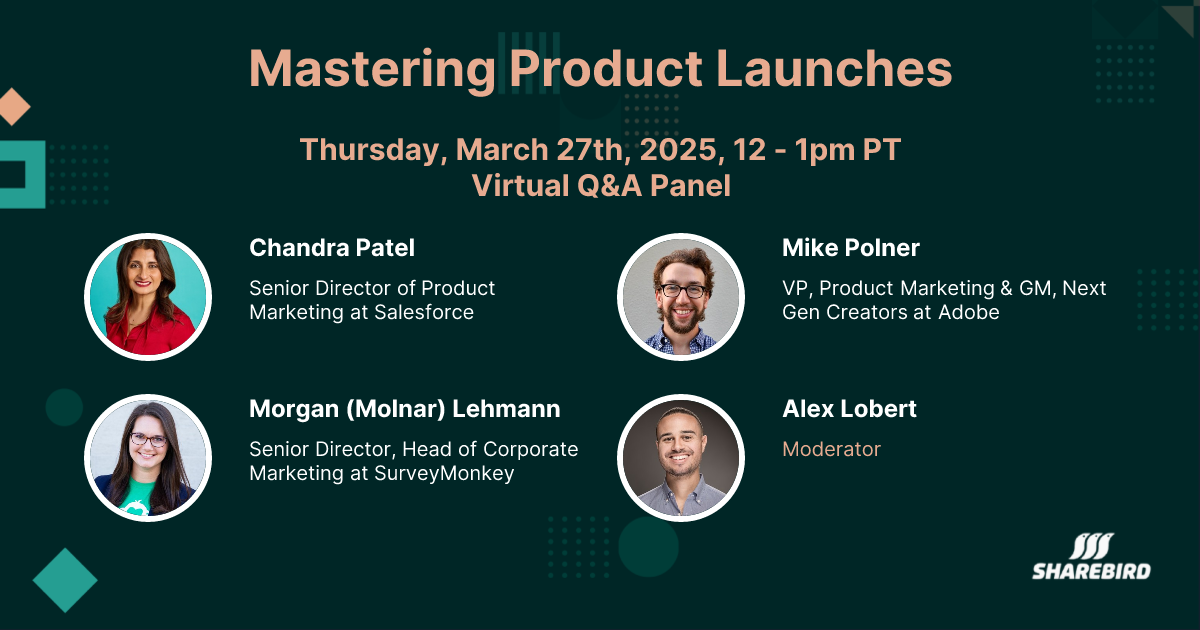
Mastering Product Launches

Mastering Product Launches

Thursday, March 27th, 2025 • 12pm–1pm PT ·

Join over 250+ product marketers to learn how PMM leaders at the fastest-growing tech companies plan and execute successful product launches that capture attention, drive adoption, and deliver business impact. This virtual event offers actionable insights and proven strategies to ensure your next product launch stands out and achieves measurable success. Don’t miss this opportunity to connect with industry peers and create a winning launch strategy.

Date: Thursday, March 27th, 12-1pm PT (3-4pm ET)
Location: Online (link will be sent to registrants prior to the event)
Cost: This event is free. However, seats are limited, so be sure to register early!

Top Questions

  • How do you define product readiness for launch?

    Morgan (Molnar) Lehmann

    SurveyMonkey Senior Director, Head of Corporate Marketing | Formerly SurveyMonkey, Nielsen • 1y

    The release date is not the launch date - they can and often should be different. At SurveyMonkey, we distinguish between when a product is released and when it's launched. While we try to keep these dates close, we often launch under experiment or limited availability first. Sometimes we get quick results showing positive impact on metrics and can proceed with a full launch. Other times, products need more refinement. For example, we have an AI-based thematic analysis feature for open-ended sur ...Read More

    505 Views
    Mike Polner
    Mike Polner

    Adobe VP, Product Marketing & GM, Next Gen Creators | Formerly Uber, Fivestars, Electronic Arts • 1y

    Product readiness is rarely a binary decision and often involves staged rollouts with both qualitative and quantitative assessments. For consumer products, launches typically aren't a sudden 0-to-1 moment but rather a staged rollout. One exception was when Uber launched tipping - we didn't do a gradual percentage rollout because it was a principled decision that wouldn't be rolled back. Generally, though, there's both a qualitative and quantitative aspect to readiness. As product marketers, we n ...Read More

    506 Views
  • What strategies have you seen work best for generating pre-launch buzz and sustaining momentum post-launch?

    Morgan (Molnar) Lehmann

    SurveyMonkey Senior Director, Head of Corporate Marketing | Formerly SurveyMonkey, Nielsen • 1y

    Leverage early access programs to generate customer stories that fuel both pre-launch and post-launch momentum. Customer involvement is key to building and sustaining momentum. With our early access or beta programs, we try to secure customer stories early. This drives internal buzz because people know something exciting is coming that customers can test. Then, when you launch, having customer quotes ready for your press release gives it more impact. As these stories continue to develop post-lau ...Read More

    475 Views
    Mike Polner
    Mike Polner

    Adobe VP, Product Marketing & GM, Next Gen Creators | Formerly Uber, Fivestars, Electronic Arts • 1y

    Focus on internal excitement and target influential early adopters to create a ripple effect. It's crucial to generate internal buzz so your team feels the excitement about a major launch. Paint the vision of not just a single moment but a series of drumbeats. Sell it internally so people understand the importance. Externally, recognize that all customers aren't created equal - a small set of people drive a disproportionate amount of conversation, activity, purchases, or usage. Find those influe ...Read More

    500 Views
  • What are the biggest mistakes companies make when launching a new product, and how can they be avoided?

    Morgan (Molnar) Lehmann

    SurveyMonkey Senior Director, Head of Corporate Marketing | Formerly SurveyMonkey, Nielsen • 1y

    The biggest mistake is focusing too heavily on the immediate launch moment without thinking about ongoing feature discoverability. When launches don't land effectively or achieve long-term success, it's often because teams concentrate solely on the launch day and then quickly move on to the next quarter's launch. Your launch plan should incorporate always-on methods for driving awareness and usage of key features, especially those that lead to stickier customers or upgrades. A recent example fro ...Read More

    492 Views
    Chandra Patel
    Chandra Patel

    Salesforce Senior Director of Product Marketing • 1y

    Not grounding the launch in clear value positioning and stakeholder alignment leads to failure. From an operational standpoint, if you haven't established the value proposition and positioning with alignment across stakeholders upfront, you'll either have a bad launch or just check boxes without seeing real impact. This alignment requires significant effort with executives to ensure everyone is on the same page. I recommend using a launch brief framework to document what you're doing and why, es ...Read More

    504 Views
    Mike Polner
    Mike Polner

    Adobe VP, Product Marketing & GM, Next Gen Creators | Formerly Uber, Fivestars, Electronic Arts • 1y

    If your strategy is poor, your launch will fail no matter how well you execute. While project management is important, having a bad strategy means you're solving the wrong problem, and everything will fall apart. For example, if you're trying to drive more subscriptions from existing customers who already use your product extensively, but you decide to run a huge outdoor campaign, your strategy isn't aligned with your business objective. This misalignment will eventually surface when the launch ...Read More

    528 Views
  • Do you have a tiering system? And can you talk about how this is influenced? Actually, how you go to market?

    Mike Polner
    Mike Polner

    Adobe VP, Product Marketing & GM, Next Gen Creators | Formerly Uber, Fivestars, Electronic Arts • 1y

    Tiering systems are essential, but you also need flexibility for unexpected opportunities. While it's important to have a structured tiering system as you plan your roadmap and organize your major and minor moments, you should always leave some space for unexpected developments. When the CEO or product team gets excited about something new, you need to have the flexibility to either accommodate it or strategically bundle it with other initiatives. Essentially, expect the unexpected when creating ...Read More

    510 Views
    Morgan (Molnar) Lehmann

    SurveyMonkey Senior Director, Head of Corporate Marketing | Formerly SurveyMonkey, Nielsen • 1y

    Yes, we use a tiering framework that considers both market launch tiers and customer impact tiers. For market launches, we have three tiers: Tier 1 is for major features or new products that drive their own revenue and deserve their own spotlight. Tier 2 is for thematic launches, bundles of smaller related features, or strategic updates like our recent Salesforce integration update. Tier 3 is for smaller features bundled into monthly release notes, quarterly refreshes of our what's new page, or ...Read More

    466 Views
    Chandra Patel
    Chandra Patel

    Salesforce Senior Director of Product Marketing • 1y

    We use a similar tiering approach with small, medium, and large launches. For smaller enhancements, we have standard ongoing activities like release webinars, which are highly attended and keep customers and prospects educated. For bigger announcements, we think strategically about how to maximize impact with limited resources. We often anchor major launches to big events or industry gatherings where we can unveil the product with analysts present and follow up with activities like dinners to bu ...Read More

    537 Views
  • How can product marketers improve their project management skills?

    Morgan (Molnar) Lehmann

    SurveyMonkey Senior Director, Head of Corporate Marketing | Formerly SurveyMonkey, Nielsen • 1y

    Tap into internal expertise and use feedback to continuously improve. Find the project management experts at your company and learn from them. At SurveyMonkey, our PMO (Program Management Organization) recently published all their templates on our company wiki for everyone to use. Additionally, feedback is crucial for improvement. As a manager coaching junior product marketers through go-to-market processes, I'll join meetings and take notes in the background, then provide feedback afterward. I ...Read More

    469 Views
    Chandra Patel
    Chandra Patel

    Salesforce Senior Director of Product Marketing • 1y

    Learn from existing methodologies in your organization and find templates to build your foundation. If your company follows a specific project management methodology, leverage that as it's already understood in your organization. This might be more available in mid-size or larger companies. For more scrappy approaches, look for templates on platforms like Sharebird for launch templates and project plans. Do some reading on frameworks like RACI or DACI models that define roles (who's the approver ...Read More

    492 Views
  • How do you manage product launches when budget is tight?

    Mike Polner
    Mike Polner

    Adobe VP, Product Marketing & GM, Next Gen Creators | Formerly Uber, Fivestars, Electronic Arts • 1y

    Nobody ever has enough budget, so get creative with in-product and owned channels. At Discord, which is a social platform with many daily users, we leverage in-product channels to reach customers directly. For example, last April Fools' Day, we built a loot box activation where users clicked boxes to unlock avatar decorations. After opening many boxes in this repetitive task, users received a clown decoration - essentially we were playfully trolling our users. People opened billions of these box ...Read More

    464 Views
    Chandra Patel
    Chandra Patel

    Salesforce Senior Director of Product Marketing • 1y

    Focus on owned channels and authentic voices to maximize impact without large budgets. I always start by thinking about our owned channels like social media. Beyond just doing clever marketing campaigns, we look for authentic voices within our organization that we can promote. Having product experts or product leadership share why they chose to build a particular feature and its value can go a long way. We coach the product team on how to write these messages and review them together. Additional ...Read More

    486 Views
    Morgan (Molnar) Lehmann

    SurveyMonkey Senior Director, Head of Corporate Marketing | Formerly SurveyMonkey, Nielsen • 1y

    It's rare to have dedicated budget for product launches, so leverage existing channels and get creative. I focus on owned channels first and foremost. PR, Social, Email, Web, In-Product. We have monthly "What's New" videos, quarterly updates to a "What's New" webpage, and quarterly 'What's New' webinars that we're already promoting as part of our evergreen marketing. Get employees to amplify! If you have full-funnel digital advertising live, consider slotting in fresh product messaging in the lo ...Read More

    919 Views
  • How do you communicate launch tiers to product partners who might be disappointed with their feature's tier designation?

    Morgan (Molnar) Lehmann

    SurveyMonkey Senior Director, Head of Corporate Marketing | Formerly SurveyMonkey, Nielsen • 1y

    Using customer impact tiers can help ease the tension when a feature doesn't get a high-profile external launch. Sometimes product managers might be heartbroken when their feature isn't supported as a Tier 1 or 2 launch. That's where our customer impact tiers help. If it's a feature that isn't particularly differentiated in the market but customers have been asking for it and will be excited about it, we can still be enthusiastic in our communications to customers. This approach ensures the feat ...Read More

    449 Views
    Mike Polner
    Mike Polner

    Adobe VP, Product Marketing & GM, Next Gen Creators | Formerly Uber, Fivestars, Electronic Arts • 1y

    Building strong relationships and alignment around priorities is the foundation for these conversations. When you're misaligned with your product partner about a launch tier, take it up a level and examine why the misalignment exists. Is it because internally we think something is interesting but customers aren't interested? Often, the issue isn't binary (supporting vs. not supporting a launch), but rather about how you're supporting it. Sending an email is supporting it, while hosting an entire ...Read More

    469 Views
  • What product launch KPIs do you set and track and how long to you track them for?

    Chandra Patel
    Chandra Patel

    Salesforce Senior Director of Product Marketing • 1y

    Track a mix of leading and lagging indicators, with revenue impact as the ultimate measure. It's challenging to measure the impact of product marketing and launches, but we try to move beyond simple activity metrics. We look at ACV (Annual Contract Value) impact, and I particularly focus on time to first revenue associated with the launch - if you can accelerate this, it indicates your message is resonating. For event-related launches, we examine marketing-driven pipeline as a leading indicator, ...Read More

    783 Views
    Morgan (Molnar) Lehmann

    SurveyMonkey Senior Director, Head of Corporate Marketing | Formerly SurveyMonkey, Nielsen • 1y

    Focus on long-term adoption metrics rather than launch-day vanity metrics. Sometimes we get distracted by vanity metrics like PR impressions, web traffic, newsletter click-throughs, or other immediate indicators. Instead, we should anchor on longer-term success metrics around feature adoption - what percentage of users have tried or are using the feature, package mix shifts if the feature is attached to a paid plan, or attach rates and impact to average order values for new sales SKUs. These met ...Read More

    485 Views
    Mike Polner
    Mike Polner

    Adobe VP, Product Marketing & GM, Next Gen Creators | Formerly Uber, Fivestars, Electronic Arts • 1y

    Set one primary goal with secondary goals beneath it, and consider 'number of fires' as an important KPI. You should clearly document the problem you're solving in a brief that's socialized across the organization. Establish one primary goal with several secondary goals beneath it, maintaining this hierarchy throughout the process. Beyond traditional metrics, I consider 'number of fires' to be a crucial KPI. When a launch goes smoothly, people often don't realize how well it went. We create scen ...Read More

    512 Views
  • How do you get buy-in from other marketing stakeholders that control the budget?

    Morgan (Molnar) Lehmann

    SurveyMonkey Senior Director, Head of Corporate Marketing | Formerly SurveyMonkey, Nielsen • 1y

    For smaller launches that won't generate new leads, focus on owned channels rather than requesting additional budget. If a launch is small and won't generate new leads, I wouldn't spend money on it - I'd keep it to owned, free, or sunk-cost channels. To influence paid marketing teams who manage various channels throughout the funnel, make sure your go-to-market calendar is on their radar. At SurveyMonkey, we've become more agile since bringing paid marketing management in-house, which gives us f ...Read More

    496 Views
    Mike Polner
    Mike Polner

    Adobe VP, Product Marketing & GM, Next Gen Creators | Formerly Uber, Fivestars, Electronic Arts • 1y

    Not every launch needs paid support, and that's perfectly acceptable. If your business goal isn't directly tied to revenue or reaching people outside your existing environment, it's okay not to use paid channels. The decision should be based on your specific goals and what you're trying to accomplish. If paid support does make sense, remember that it doesn't have to be just direct response performance marketing - you could use influencers or other approaches. The key is aligning the channel stra ...Read More

    490 Views
  • What are the roles that PMM play during a launch at your organization?

    Chandra Patel
    Chandra Patel

    Salesforce Senior Director of Product Marketing • 1y

    Product marketers must be strong project managers who bring everyone together and drive toward outcomes. I always start with a kickoff meeting where everyone aligns on goals, dates, roles, responsibilities, and actions to be delivered. This prevents misalignment by getting everyone on the same page from the beginning. In today's environment where asynchronous communication is common, I insist on structured updates in project channels rather than just DMs. Walking through the project board regula ...Read More

    511 Views
    Morgan (Molnar) Lehmann

    SurveyMonkey Senior Director, Head of Corporate Marketing | Formerly SurveyMonkey, Nielsen • 1y

    Product marketers at SurveyMonkey are some of our best cross-functional project managers, a skill learned by necessity. The discipline of regular check-ins and keeping people aware of progress both asynchronously and in meetings is crucial. Our biggest challenges often come not from strategy or planning misalignment but from dealing with delays. When timelines shift, we have to determine if everything is delayed or just certain components, and whether we can still proceed with parts of the launc ...Read More

    490 Views
    Mike Polner
    Mike Polner

    Adobe VP, Product Marketing & GM, Next Gen Creators | Formerly Uber, Fivestars, Electronic Arts • 1y

    Product marketers need to drive alignment across four key areas to ensure successful launches. First, they must establish the right strategy - ensuring people understand why we're building and launching this product. Second, they need to create the right structure with clear roles and responsibilities, determining who's driving and who's a passenger. I use the car analogy: many people can be in the car, but only one person has their hands on the wheel. Third, they must implement the right proces ...Read More

    481 Views

See Event Answers

Speakers (3)

  • Chandra Patel

    Chandra Patel

    Senior Director of Product Marketing · Salesforce

    View Profile
  • Mike Polner

    Mike Polner

    VP, Product Marketing & GM, Next Gen Creators · Adobe

    View Profile
  • Morgan (Molnar) Lehmann

    Morgan (Molnar) Lehmann

    Senior Director, Head of Corporate Marketing · SurveyMonkey

    View Profile