
Sharebird
All events

This event has ended!

Virtual Event
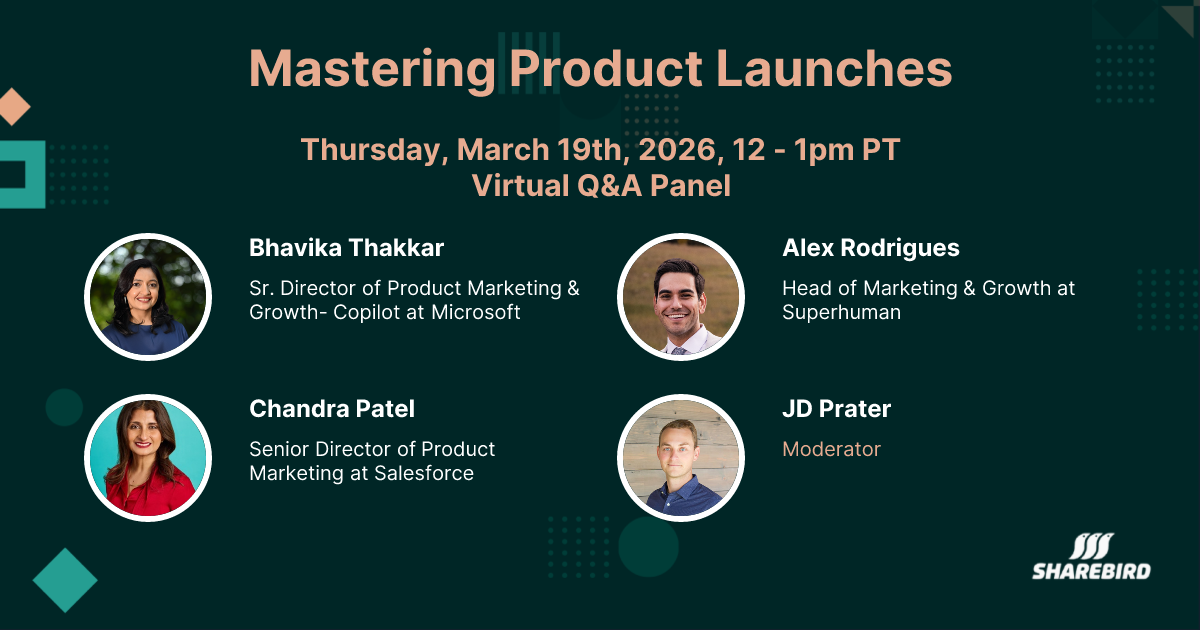
Mastering Product Launches

Mastering Product Launches

Thursday, March 19th, 2026 • 12pm–1pm PT ·

Are you looking to level up how you plan, execute, and lead product launches?
Join the Sharebird community for a live Q&A with experienced Product Marketing leaders who’ve owned high-stakes launches across growth stages and org models.

We’ll dig into what actually makes launches successful—from setting clear strategy and cross-functional alignment, to avoiding common pitfalls, measuring impact, and adapting when things don’t go as planned. This session is designed to be practical and candid, with real examples, lessons learned, and plenty of time for your questions. You’ll walk away with proven frameworks, tactical guidance, and fresh perspective you can immediately apply to upcoming launches—whether you’re leading your first major release or refining a repeatable launch motion.

  • Date: Wednesday, March 19th, 12–1 pm PT (3–4 pm ET)

  • Location: Online (link sent to registrants prior to the event)

  • Cost: This event is free. However, seats are limited.

Top Questions

  • What's the strategy on launching products that are really just parity products?

    Alex Rodrigues
    Alex Rodrigues

    Superhuman Head of Marketing & Growth | Formerly Google, Plaid, early Venmo • 2mo

    Find the small but real points of differentiation within the parity feature, and don't oversell it — communicate honestly about what was built and why it's great. Key strategies: 1. **Find differentiation within the parity**: For example, Superhuman launched Booking Pages — a feature Google, Outlook, and Calendly all have. But what made it magical was the end-to-end journey: inserting available times while drafting an email, which is Superhuman's core bread and butter. Lean into that unique expe ...Read More

    543 Views
    Bhavika Thakkar
    Bhavika Thakkar

    Microsoft Sr. Director of Product Marketing & Growth- Copilot | Formerly Adobe, GoDaddy, Xero • 2mo

    Lead with customer stories and use cases rather than feature differentiation — even when you're behind the competition, you can win by showing how the product improves customers' lives. Apple is a great example: Apple didn't always have the best camera compared to Samsung, but camera was still their focus and differentiating value prop. They won the market by telling customer stories and highlighting special moments in the customer journey. Applying this to parity launches: - Put customer storie ...Read More

    528 Views
    Chandra Patel
    Chandra Patel

    Salesforce Senior Director of Product Marketing • 2mo

    Tier your launches — parity features are still launches and still valuable to customers. Think of launches as either building a more complete solution or driving innovation, and size your bill of materials accordingly. Key principles: - **Tier your launches**: Whether extra small or extra large, your bill of materials (BOM) should match the size. A launch is still a launch — it doesn't have to be big, shiny innovation. - **Two sides of a coin**: Launches either build a more complete solution/bet ...Read More

    541 Views
  • What are some of the biggest mistakes you've made with product launches and how can we avoid them?

    Bhavika Thakkar
    Bhavika Thakkar

    Microsoft Sr. Director of Product Marketing & Growth- Copilot | Formerly Adobe, GoDaddy, Xero • 2mo

    Launching a completely new experience with big PR coverage before the product was truly ready — guardrail metrics were way below threshold — highlighted that PMMs need a strong voice at the product leadership table about market readiness. The situation: Launched a completely new experience intended to become the future default experience. It received amazing PR coverage across flagship media outlets. However, the product did not deliver — all guardrail metrics were well below the threshold neede ...Read More

    528 Views
    Alex Rodrigues
    Alex Rodrigues

    Superhuman Head of Marketing & Growth | Formerly Google, Plaid, early Venmo • 2mo

    Superhuman's collaboration feature launch was positioned as 'Superhuman 2.0' — a complete platform relaunch — which made it harder to drive awareness of individual features and adoption. A more focused, tiered approach would have worked better. Superhuman built collaboration features into the email product — sharing email threads like a doc, commenting with your team, sharing drafts. It's a powerful shift from single-player to multiplayer email. However, it was positioned as 'Superhuman 2.0' and ...Read More

    516 Views
    Chandra Patel
    Chandra Patel

    Salesforce Senior Director of Product Marketing • 2mo

    Going too broad with the ICP on a product launch led to interest from people who weren't the actual decision makers — tightening ICP definition earlier would have shortened sales cycles. The situation involved a product helping sales teams with learning and development and enablement. The ICP was defined too broadly — there were enablement managers, learning and development teams, and competitors with broader value propositions. The result: lots of interest in deals, but often talking to people ...Read More

    531 Views
  • What are some considerations for launching something new for your company in a highly saturated, competitive market?

    Bhavika Thakkar
    Bhavika Thakkar

    Microsoft Sr. Director of Product Marketing & Growth- Copilot | Formerly Adobe, GoDaddy, Xero • 2mo

    Focus on ecosystem differentiation and business model differentiation as your two key pillars when launching in a saturated market. Two main pillars: 1. **Ecosystem differentiation**: When the product as a standalone doesn't hold its own against established competitors, the ecosystem or collection of user journeys and features makes a stronger story. For example, at Adobe, the differentiation wasn't the stock marketplace product itself, but the ecosystem it lived in and its connections with othe ...Read More

    537 Views
    Alex Rodrigues
    Alex Rodrigues

    Superhuman Head of Marketing & Growth | Formerly Google, Plaid, early Venmo • 2mo

    Be laser-focused on who you're building for, leverage social proof, and build in public to create hype and pull demand before broad availability. Key strategies: 1. **Laser focus on the customer**: Know exactly who you're building for, what their challenges are, and how you solve them. The platform/ecosystem element is important — there may already be lock-in with existing product users. 2. **Building in public**: Run alphas and betas, and find big voices (e.g., people with large Twitter followi ...Read More

    535 Views
    Chandra Patel
    Chandra Patel

    Salesforce Senior Director of Product Marketing • 2mo

    Always anchor on differentiation ('why is doing it here better?'), align your go-to-market stakeholders early, hone your ICP, and use pilot customers to build real customer stories. Key considerations: 1. **Differentiation**: Always ask, 'Why is doing it here better?' This ties back to the ecosystem point — big company or small, differentiation has to be front and center. 2. **Stakeholder alignment**: Ensure alignment across go-to-market distribution and product leadership. Spend the right time ...Read More

    530 Views
  • What's PMM's role in product enablement vs GTM launch enablement vs. sales enablement, if there are differences

    Bhavika Thakkar
    Bhavika Thakkar

    Microsoft Sr. Director of Product Marketing & Growth- Copilot | Formerly Adobe, GoDaddy, Xero • 2mo

    Specificity in battle cards is increasingly critical — sellers need specific prompts and concrete comparisons, not fluffy language, especially in a competitive AI landscape. In a market where multiple AI tools offer the same value proposition, sellers are asking for very specific guidance — for example, exact prompts that work in one tool versus another, and how that adds value. Specificity versus fluffy language is resonating much better in this extremely competitive era. The more PMMs get clos ...Read More

    539 Views
    Alex Rodrigues
    Alex Rodrigues

    Superhuman Head of Marketing & Growth | Formerly Google, Plaid, early Venmo • 2mo

    Battle cards are more important than ever in the AI era, because there are more 'tire kickers' and customers are asking more comparison questions — specific, detailed battle cards help sales answer those questions in the way PMM wants. In the AI world, there are a lot more tire kickers, meaning customers are having more conversations and asking more comparison questions: 'How do you compare with this? How do you compare with that?' Having really solid, specific battle cards allows the sales team ...Read More

    559 Views
    Chandra Patel
    Chandra Patel

    Salesforce Senior Director of Product Marketing • 2mo

    Battle cards and sales enablement assets absolutely still matter — the key is building a regular cadence with sellers to understand what's working and delivering targeted, bite-sized enablement. Key practices: 1. **AE Council**: Maintain an AE Council (not just sales leadership) that provides input on what's working, what's needed, and what they like. This ensures enablement is delivering real value to sellers. 2. **AI-accelerated battle cards**: AI is helping write battle cards faster and at sc ...Read More

    542 Views
  • When launching in a crowded or parity market, how do you actually create differentiation that customers can feel?

    Chandra Patel
    Chandra Patel

    Salesforce Senior Director of Product Marketing • 2mo

    Storytelling is the PMM secret sauce for creating differentiation that customers can feel — and it's something AI won't fully replace. The key is storytelling, and it comes from experience. Classic storytelling structure applied to product launches: - **Who is the hero?** (The customer) - **What challenge are they facing?** - **How do you come in and save the day?** Even a simple one-slide structure — 'it's this, then it's this, then it's this' — can be very powerful in helping you understand ho ...Read More

    560 Views
    Alex Rodrigues
    Alex Rodrigues

    Superhuman Head of Marketing & Growth | Formerly Google, Plaid, early Venmo • 2mo

    Product experience and speed matter — pushing for craft and polish in the product itself creates differentiation that customers feel viscerally. Storytelling is the PMM secret sauce (fully agreed). On the 'feel' dimension specifically: product experience matters enormously. At Superhuman, there is a 100-millisecond rule — no interaction should take more than 100 milliseconds, because after that, something starts to feel slow. The team constantly pushes on: - Why isn't this faster? - How can we m ...Read More

    548 Views
    Bhavika Thakkar
    Bhavika Thakkar

    Microsoft Sr. Director of Product Marketing & Growth- Copilot | Formerly Adobe, GoDaddy, Xero • 2mo

    Focus on the customer's day-in-the-life and the benefit you're delivering — not the features — to create differentiation that customers can actually feel. A specific example from the SMB segment: SMB owners wear multiple hats — running bills at night, making pizzas in the morning, serving them in the evening. Rather than leading with features and competitor comparisons, the approach was: - Paint a 'day in the life' of the customer. - Show how the product gives them more time with their family. - ...Read More

    570 Views
  • What's a leading indicator of launch success that most teams overlook?

    Chandra Patel
    Chandra Patel

    Salesforce Senior Director of Product Marketing • 2mo

    Sentiment can be measured in many ways — including PR interest, event attendance, and session capacity — and getting in front of customers pre-launch is key to gauging whether your value proposition is resonating. Ways to measure sentiment: 1. **PR interest**: Who wants to talk to you about this as you're launching it? Media interest is a signal. 2. **Event attendance and session capacity**: For example, a content track at Dreamforce around account plans was so popular that sessions had to keep ...Read More

    554 Views
    Bhavika Thakkar
    Bhavika Thakkar

    Microsoft Sr. Director of Product Marketing & Growth- Copilot | Formerly Adobe, GoDaddy, Xero • 2mo

    Running a demo by your customer advisory board before launch and watching their reaction is a powerful leading indicator of success.

    Before launching, run the demo by your customer advisory board. If jaws drop, that's a clear signal that you need to make a big deal about this launch. The reaction from customers — even before the product is publicly available — is a very important leading indicator of how the market will respond.
    543 Views
    Alex Rodrigues
    Alex Rodrigues

    Superhuman Head of Marketing & Growth | Formerly Google, Plaid, early Venmo • 2mo

    Sentiment — measured through social listening, invites, and referrals — is a leading indicator most teams overlook. There are multiple ways to measure sentiment: 1. **Social listening**: See what people are saying about your product or feature. (Caveat: try to stay off Reddit for your own product.) 2. **Invites and referrals**: For a seat-based business, when people are excited about a launch, they add coworkers or send referrals. This is a monetizable way to measure sentiment — it shows custome ...Read More

    536 Views
  • With parity features, PR often prefers not to mention them loudly since they show we are behind the competition. What are your thoughts on that?

    Chandra Patel
    Chandra Patel

    Salesforce Senior Director of Product Marketing • 2mo

    PR is right that coverage on product announcements is hard — reserve formal PR for Tier 1 launches and use blogs, customer success stories, and other creative channels for parity features. Key points: - Getting media coverage on product announcements has always been difficult, so PR teams are just being realistic. - Reserve formal PR and press releases for Tier 1 launches — the big, real innovation. - For parity features, use your blog and customer success stories. PR teams love showcasing custo ...Read More

    544 Views
    JD Prater
    JD Prater

    Ting VP of Marketing • 2mo

    Use the PR FAQ framework to align internally, and consider founder-led PR as an alternative channel — not everything deserves a press release. Additional strategies: 1. **PR FAQ framework**: Write out the press release and FAQs before anything is even built. The FAQs address where customers will be excited and where they'll be disappointed — a great alignment tool with product teams. 2. **Not everything deserves PR**: That's a valid and important principle to internalize. 3. **Founder-led PR**: ...Read More

    519 Views
    Bhavika Thakkar
    Bhavika Thakkar

    Microsoft Sr. Director of Product Marketing & Growth- Copilot | Formerly Adobe, GoDaddy, Xero • 2mo

    You may not need PR at all for parity features — focus on influencer evangelists and social proof, or use a case study angle if you do go through PR. Two approaches: 1. **Skip traditional PR**: Focus instead on influencer evangelists and advocates on social media to create buzz through those channels. Social proof can be more effective than a press release for parity features. 2. **Case study route through PR**: If you do go through PR, frame it as a customer success story — 'We implemented this ...Read More

    550 Views
  • How do I master product launches with AI?

    Chandra Patel
    Chandra Patel

    Salesforce Senior Director of Product Marketing • 2mo

    AI is helping accelerate two key areas: creating the launch brief and enabling seller readiness at scale. There are two main tranches where AI is making a real difference: 1. **Standardizing the launch brief**: Using AI to develop the first draft of a launch announcement — taking all the innovation and generating what the announcement should be. Getting that first draft has historically been a big exercise, and AI makes it much faster. 2. **Seller enablement and competitive readiness**: Once mes ...Read More

    543 Views
    Alex Rodrigues
    Alex Rodrigues

    Superhuman Head of Marketing & Growth | Formerly Google, Plaid, early Venmo • 2mo

    AI enables hyper-personalization at scale and gives PMMs new superpowers to influence stakeholders and drive outcomes across the organization. Two key additions to the mix: 1. **Hyper-personalization at scale**: Combining product signals (how someone is using the product, where they're stuck in the funnel) with enrichment data (e.g., from Clay) to deliver highly personalized messages. Combining product signals with market signals allows for orders-of-magnitude more personalized automations than ...Read More

    557 Views
    Bhavika Thakkar
    Bhavika Thakkar

    Microsoft Sr. Director of Product Marketing & Growth- Copilot | Formerly Adobe, GoDaddy, Xero • 2mo

    AI accelerates competitive analysis, messaging gut checks, audience-specific copy, and creative development — all helping get products to market faster. Key ways AI is being used: 1. **Competitive analysis**: Quickly running gut checks on positioning statements and messaging. 2. **Audience-specific messaging**: With AI, decision-making power has shifted from technical decision makers to end users. AI helps rapidly adapt core messaging for different audiences — IT TDMs, BDMs, C-suites, and end us ...Read More

    1,300 Views

See Event Answers

Speakers (3)

  • Bhavika Thakkar

    Bhavika Thakkar

    Sr. Director of Product Marketing & Growth- Copilot · Microsoft

    View Profile
  • Alex Rodrigues

    Alex Rodrigues

    Head of Marketing & Growth · Superhuman

    View Profile
  • Chandra Patel

    Chandra Patel

    Senior Director of Product Marketing · Salesforce

    View Profile